I am grateful to have had the opportunity to explore some of the deeper issues with my friend CK Lin on his podcast.
To listen, please go to this link of the interview for either audio or video.
Enjoy!

To create systems of societal change, we need to become clearer about the archetypes of societal change strategies, their strengths and weaknesses, and their interactions. By Steve Waddell Spring 2018

(Photo by Alex Wong/Getty Images)
Greenpeace, The Nature Conservancy (TNC), the Forest Stewardship Council (FSC), and Unilever all tout their commitment to change in support of the natural environment. But a look at their websites reveals big differences in how they translate this into action.
In July 2016, Greenpeace’s homepage featured a huge “RESIST” banner attached to a construction crane with activists rappelling down, and the words “The Summer of Resistance starts with you—Bring resistance to your community!” The Nature Conservancy’s showed serene fields and “Help us protect cherished landscapes that unite us in all 50 states.” The FSC’s described its commitment to the “environmentally appropriate,” “socially beneficial,” and “economically viable” with pictures of forests, Forest Champions, and businesses. And Unilever’s showed a picture of a farmer in a developing country and the words “Sustainable Growth: Value + Values. We are changing the way business is done.”
Responding to a difficult challenge such as environmental sustainability can produce a wide range of actions. How can diverse change efforts that aim for a similar outcome be thought of comprehensively? What are their relationships? How do they interact most powerfully to speed change? These questions led me to conceive of all the diverse efforts to create change on a difficult issue such as climate change or poverty, collectively as a “societal change system.” Such a system comprises all those initiatives and programs that are working to change a situation or issue. Seeing the whole of this system—through mapping, data visualization, and other methods—yields unique insights about how to create coherence; identify gaps in effort; exploit synergies; and reduce duplication, conflict, and inefficiencies.
Economist Joseph Schumpeter’s famous description of the “creative destruction” of capitalism is instructive for change more broadly. There is a natural tendency among those who work for societal change to focus on the creative part of the task—developing the new. But change also involves destroying the old, whether it be institutions, relationships, or ways of doing things.
Schumpeter’s insight into the continuous churn of free markets forms the basis for proposing one dimension for distinguishing change strategies: destruction to creation. Extreme destruction might be depicted as the collapse of civilization; less extreme forms might include the rejection of a traditional social value or the breakup of a company. The extreme of creation is captured by the birth of a whole new societal order, while a less extreme form of creation might be the formation of a company or the adoption of a new social practice.
A second dimension is confrontation to collaboration. The extreme of confrontation is war, but there are many less confrontational actions, such as those of Greenpeace activists. At the collaboration extreme, consider the facilitation of deep mutual respect and common commitment in a group to work together to realize a change goal through transcendence of diverse perspectives, similar to the FSC’s work.
These two dimensions form the basis of a matrix that captures four kinds of change strategy. (See “Change Strategies” below.) Each quadrant is named for the archetype of change it reflects. I have developed this model over 20 years of work on large systems change internationally—for example, on poverty in Guatemala, global corruption, renewable energy, and the financial system.
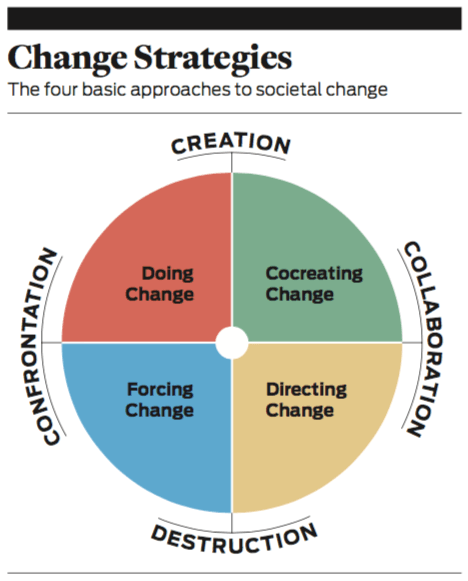
How do we transform a group of well-intended but collectively incoherent change initiatives into a powerful societal change system? The matrix serves as a device to raise valuable questions and spark insights for understanding change strategies or initiatives holistically. All change initiatives reflect some mix of the two dimensions. Although a particular change initiative may shift position within a quadrant as it evolves and its emphasis on particular dimensions changes, moving to a different quadrant would transform its core logic—its rationale, principles, and capacities.
To further explore this model, I also offer a table that describes each quadrant generically and then addresses our two examples of societal change. (See “Characteristics of Change Strategies” below.) Let us first examine each of the quadrants generically, then turn to the two cases.
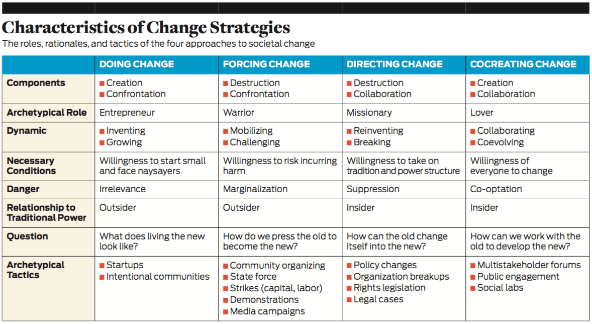
Doing Change: The Entrepreneurs | The upper-left quadrant is that of entrepreneurs who are out to create a new approach that defies the prevailing logic and ways of operating. This often takes the form of a social or commercial enterprise. The entrepreneur can be an individual, but for societal impact it is more often an organization or movement. Social innovation labs, Ashoka Fellows, and Impact Hubs all specialize in nurturing this type of activity. In business, this category covers entrepreneurs who are causing radical change, such as M-Kopa (providing solar energy in Kenya through innovative financing) and Revolution Foods (bringing healthy food to K-12 schools).
Entrepreneurs are not fixated on destroying the old, although that is typically the effect of their innovation. Their energy is devoted toward creating the new. These change agents usually face substantial skepticism and resistance by incumbents. This, problems with scaling, or simply the inadequate power of the invention may make the entrepreneurs unable on their own to bring about broad societal change.
Forcing Change: The Warriors | Activists as warriors are the archetype of the lower-left quadrant. They are the energy pushing for widespread change, trying to influence others through their pressure and advocacy. They must be willing to risk harm—perhaps only breaking windows, perhaps forcing a business to close and lay off workers, perhaps breaking the law. They focus on gathering strength through followers and supporters often associated with social movements. However, in the same way that social activists can attempt to force change through warrior-like tactics, capitalists can withdraw investment in the name of change, and governments can use the power of the state to incarcerate and fine resisters of change. The danger for this quadrant is failure to gather sufficient support and power to emerge from the margins—which leads some to become more violent and can even result in civil war.
Directing Change: The Missionaries | Those who are in positions of power and authority and are committed to change have a particularly challenging position. They can use that power and authority to secure change, but that often requires fundamental disruption in the structures that give them power and authority in the first place. They typically have a missionary’s zeal often associated with charisma for pursuing transformation, since such work involves overcoming immense inertia to break up and reinvent organizations and structures to become something very different. Their energy can easily be suppressed by status quo interests and skepticism that arise from trying to create something that no one has yet seen or experienced fully. Unilever CEO Paul Polman is an example of someone grappling with this change strategy to create a new business model that does not just do “less bad” but contributes positively to all aspects of society.
Cocreating Change: The Lovers | This is the popular but complicated strategy of “Let’s get all the stakeholders in the same room and figure out how we’ll work together for change.” It can be described as the “lover” strategy, because it is based on the proposition that people want the same thing and are willing to work together to get it. It depends on the willingness of everyone to change, since almost always every participant is part of a transformational problem—it’s not just others that have to change, but we all hold values, beliefs, and ways of understanding that have to change. Along the way, however, a more powerful or well-resourced stakeholder may induce others to settle for less change than is needed, resulting in co-optation.
To illustrate these four archetypes of change at work, let us turn to Energiewende in Germany, the first of two case studies of largescale societal change that help to flesh out the model. The term “Energiewende” was introduced in 1980 by Germany’s Institute for Applied Ecology (Öko-Institut e.V.) as a call to abandon nuclear and petroleum-based energy. Translated as “energy transition,” it describes Germany’s commitment and ongoing transition to a sustainable energy future. In 2016, about a third of energy consumed in Germany came from renewables. (By contrast, about 15 percent of US energy consumption came from renewables, with a large amount of that from hydropower.) On one auspicious day in April 2017, Germany received a whopping 85 percent of its electricity from renewables. As a change challenge, the case is distinctive for the important role of technology.
In terms of change strategy, Energiewende illustrates the role of cocreation. Such an approach is part of the core post-World War II logic of Germany more broadly, as seen in joint labor-management boards for companies and in coalition governments. In the energy sphere, this approach was demonstrated in the 1980s with collaborative experimental work on alternative energy by the science, engineering, and industrial communities. Although there have been some shifts in strength, there has been broad support publicly for the change.
The ongoing collaborative approach must be understood in contrast to the United States: In Germany there is no oil and gas industry, so the main question was how to achieve sustainable energy technologically, financially, and pragmatically, by transitioning (destroying) traditional forms of power generation. Along the way, more widespread collaborative strategies for implementation have included broad public consultation and engagement around specific aspects of Energiewende, such as development of new transmission-line corridors.
This cocreation logic supported a directing-change approach reflected in 1991 national legislation called the Feed-In Tariff Act (FITS). It comprised two key elements: one requiring electric utilities to purchase electricity from renewable energy sources at minimum prices higher than the electricity’s real economic value, and the second requiring consumers to carry the financial burden.
This approach also supported a doing-change movement for energy transformation that pushed more decentralized energy generation. Farmers became solar and wind farmers, as well as agricultural producers; subsidies for solar panels led to widespread generation by homeowners. This doing-change activity became critical following the legislation, as a myriad of small producers of solar and wind energy arose. Individuals who earlier had thought of themselves simply as farmers or homeowners became energy producers as they installed wind turbines and solar panels. Individuals who were traditionally consumers combined energy production for sale through solar installations on their properties to become “prosumers.”
This has had wide-ranging implications for other directing-change actions, such as the decision in 2014 by Germany’s top utility, E.ON, to sell off (a form of “destruction”) its traditional coal and nuclear power businesses entirely, in order to focus on clean energy, power grids, and energy-efficiency services.
The distinctions among the four strategies can be blurred. For example, the city of Munich is working with the utility it owns to become, by 2025, the first city of more than a million residents to use 100 percent renewable energy. Given the city’s ownership of the utility, this can be seen as a directing-change strategy. But it also can be seen as a collaborative strategy, considering that it is a product of multiple stakeholder groups working with the producer and owner. And it is a doing-change strategy, considering that a geographic location has decided to simply go ahead and create the new system.
The energy transition is not occurring without resistance. But the main questions concern how to transition—with traditional energy generators and energy-intensive industries being the primary losers, who were largely bought off by the structure of FITS. As the new energy producers grew in number, they became key advocates for pushing ahead with the transition when it looked as if it might falter. Political mobilization was critical as a forcing-change strategy, leading to the Green Party joining a coalition government (1998-2005) that reinforced the original path with strengthened legislation in 2000. With local public utilities providing an important portion of the country’s energy, local elections also became periods of (re-en)forcing change with demonstrations and other actions to press forward with the energy transition.
In 2015, in an ultimate directing-change move, the US Supreme Court ruled that marriage between same-sex couples was a constitutionally protected right. Today 62 percent of Americans support it, according to the Pew Research Center. But only a half century earlier, every American state had laws that criminalized some form of same-sex sexual intimacy; until 1973 homosexuality was described as a “mental disorder” by the American Psychiatric Association; and in 1996 President Bill Clinton signed the Defense of Marriage Act, prohibiting same-sex marriage. The victory of marriage equality in the United States is arguably one of the most rapid changes ever for a core social institution and for fundamental values.
Perhaps predictably, given the very personal yet cultural quality of the issue and its US setting, the first challenges were by doing-change entrepreneurs. Individuals did not have to have someone “approve” their marriage to consider themselves married, and the United States has an individualistic tradition. Gays and lesbians simply lived as married couples, minus the legal recognition. In the 1980s, this increasingly became associated with commitment ceremonies of various forms, with those supportive of them present. Gay couples often brought children into their family from traditional marriages, through adoption, through surrogates, or simply through extended family. They became defiant role models.
On the streets, warriors took action by the public assertion of gay identity. In 1969, when policed applied routine harassment practices on homosexuals at the Stonewall Inn bar in New York City’s Greenwich Village, a riot ensued, and from this tiny, isolated protest a powerful gay rights movement grew. In 1979, between 75,000 and 125,000 individuals participated in the first national LGBT march on Washington, D.C. Gay parades became annual events in major cities, promoting gay pride and civil rights. In the 1980s, protests and aggressive actions were organized around the AIDS crisis. This experience provided a firm base for similar organizing tactics when the issue of marriage equality came to the fore in the 1990s. It became a dominant theme in the annual parades and fueled protests for legislative action.
Attempts to secure a directing-change strategy through legal rules started early. In 1970, the first legal challenge by a same-sex couple against the restriction of marriage rights to heterosexual couples was filed. The US Supreme Court dismissed it without a hearing. Gay activists took up the issue in the 1990s as the AIDS crisis forced more people out of the closet and more gays and lesbians decided they wanted the legal benefits associated with marriage. Eventually, legal victories piled up, beginning with arguments under state constitutions. In 1999, the Supreme Court of Vermont held that excluding same-sex couples from marriage was unconstitutional, prompting the legislature to create “civil unions” as marriages in all but name. The Massachusetts Supreme Judicial Court in 2003 issued the watershed ruling that made marriage between same-sex couples legal for the first time in an American jurisdiction. In 2012, voters in four states supported marriage equality through referenda—after 32 referenda had been lost around the country.
These victories built on cocreating change strategies of coalition building. Religious coalitions were especially important, given that opposition to same-sex marriage was often claimed on religious grounds as being against the will of God. At the turn of the millennium, the Religious Coalition for the Freedom to Marry in Massachusetts included more than 1,000 clergy, congregations, and organizations from 23 faith traditions. Lobbying in a warrior tradition grew into new coalitions cocreating change as Democratic Party leaders and legislators came on board.
In the background, a huge shift took place in business: By 2013, 67 percent of Fortune 500 companies offered health benefits for same-sex couples. The earliest significant examples were more experimental in a doing-it tradition, in industries that had a disproportionate number of gay employees and a more liberal workforce where employees could come out. There was a mix of concerns about fairness and ability to attract and retain employees. The early adopters gave way to a more directing-change strategy as businesses became convinced through lobbying and example setting that they should support their gay and lesbian employees.
The environment that led to this monumental shift was supported by a similar move by media companies. They started with a doing-change strategy of very occasionally bringing gay lives into popular entertainment. But this grew into a directing-change strategy, whereby the regularity of gays and gay marriage in popular entertainment became a message about what should be accepted as the new “normal.”
One of the first media breakthroughs on gay issues in general came in 1971 with an episode of the leading television sitcom All in the Family, which featured sympathetically two gay men. More direct issues of partnership, love, and commitment between two men were featured in the highly acclaimed 2005 hit movie Brokeback Mountain; the top-rated sitcom Modern Family, which premiered in 2009, included a gay couple with a child; and in 2012 Marvel Comics gave one of its superheroes a homosexual wedding, ensconcing it as a new norm to support.
Applying the framework to the two cases not only helps to clarify the strategies and logic at work, but also offers more general insights about the process of societal transformation and the workings of societal change systems. Six lessons, in particular, stand out.
Each of the four strategies can contribute critically to one transformation. All four strategies play an essential role in both cases. The energy case provided individuals with a way to realize their ideals as prosumers, to advocate in various forums their beliefs and values, to develop collaborations with the existing system to create change, and to access power in institutions to support and direct the change. In the same-sex marriage case, doing change was reflected in individuals living as though they were married; forcing change provided a chance for supporters to demonstrate their position publicly; cocreating with early adopters such as supportive clergy provided important ways to pressure the establishment; and as supporters grew in legislative and judicial forums, they created a directing-change legal environment.
This suggests that the strategies are collectively important for providing a range of ways of supporting transformation, since different people and organizations have different roles in the change process. Property owners in Germany became doing-change leaders when they became prosumers; others supported the effort by being warrior activists. In the fight for marriage equality, only gay couples were capable of doing change, whereas non-couples and the broader community could participate in forcing change through demonstrations, parades, and referenda; cocreating-change efforts were particularly important for developing more sustained interactions among institutions that were early marriage-equality supporters; and the directing-change activity gave supporters a way to create change within their own institutions and in society more broadly.
Particular transformations emphasize a particular strategy. The four strategies were not of equal importance in the cases. For Energiewende, the directing-change legislative strategy was particularly important. Its salience arose in the context of broad agreement about the end, the value of the change, and the need to focus on the means to realize carbon-free energy. Under such circumstances, the ease of doing change through modest solar and wind energy commitments by individuals was also important; this group grew in power to become particularly strong advocates to offset the influence of resisters such as major industrial electricity users and private power companies.
The marriage-equality example makes more balanced use of all the strategies, although the directing-change action was the result. The doing-change strategy was critical for bringing gay relationships into the open and creating discussions among friends and family to challenge the traditional definition of family; forcing-change activities created space for a broadening number to express their support; building coalitions across traditional religious perspectives was critical to challenging religion’s role in the debate; but it was state legislation and finally the US Supreme Court rulings that were critical to ending the debate in the face of a still-divided public.
As a transformation progresses, the comparative importance of each strategy changes. Energiewende really took off with a cocreating-change strategy generated by broad support, which opened space for a shift to the directing-change legislative action. Legislation, in turn, enabled the doing-change strategy of individuals pursuing their own renewable energy production; forcing change provided secondary support for the overall transformation. In this case, all the strategies continue to interact as the transition continues.
Doing change was the original strategy for gay couples. But this was highly marginal, until the forcing-change activities associated with the assertion of lesbian and gay equality and demands for AIDS services created space for similar marriage-equality forcing-change activities. This produced directing-change actions first by some municipalities, states, and corporations, and eventually through the final resolution by the US Supreme Court.
The particular circumstances and environment that a transformation confronts determine the order of the strategies and their interaction. In our two cases, there is a notable diversity in stage order, and there is no obvious pattern. This suggests that characteristics of the cases themselves determine interactions between the strategies.
The most obvious question is why people do not simply start in an organic fashion, with the doing-change strategy growing into widespread adoption and a new dominant way of organizing and acting. This seems to have been the case for marriage equality. However, that case demonstrates that realizing an enabling environment for doing change usually first requires some forcing-change work. An important precursor to doing-change commitment ceremonies was elimination (or at least lack of enforcement) of laws against sex acts between members of the same sex. This required substantial forcing-change action by gay activists, although their efforts started with a desire to be left alone rather than to be married.
Qualities of the change issue itself can make a doing-change strategy on its own highly problematic. There were certainly early solar and wind energy entrepreneurs, but a doing-change Energiewende strategy was destined for irrelevance in the traditional operating environment, since developing technologies at scale requires substantial investment and change in rules governing energy transmission. However, in this case a cocreating strategy of collective education was the predominant predecessor of the creation of an enabling legal environment.
Therefore, there seems to be a dual lesson on strategy interaction: In permissive enabling environments, there can indeed be an organic change process that emphasizes doing change. These are environments where legal structures and norms provide the basis for, rather than impede, experimenting and innovating culturally, technologically, and philosophically. But in the absence of such an environment, forcing change is not the only strategy possible: Cocreating change can provide an important avenue if there is broad agreement that change is needed.
Enabling environments support experimentation and the creation of networks. The fourth lesson suggests important qualities of an enabling environment to ease transformation. There is particular value in structures and traditions that support exploration: the ability to try out new lifestyles, technologies, and values associated with transformations. Institutional rigidity, narrow definitions of what is acceptable, large interdependent structures where change requires complicated coordination, and weak processes for developing broad consensus about change directions all contribute to a brittleness that is associated with more problematic transformations, such as the United States’ transition to sustainable energy. Part of this is a question of political systems and the beliefs associated with them. Both cases involve political democracies. However, the multi-party German parliamentary system is more change friendly, as demonstrated by the important role of the Green Party. The range of options in the one-party Chinese system, for example, would be very different.
However, an enabling environment is not simply one of passive acceptance of diversity. The marriage-equality case demonstrates the importance of creating networks and adopting forcing-change strategies as well. The German case represents the importance of creating large-scale conversations and experimenting with transformational challenges to promote a cocreating-change strategy.
Each strategy requires distinct competencies. This article began by observing that different change organizations tend to be associated with different strategies. The cases illuminate the distinct tactics associated with each strategy, which in turn implies that they require different competencies. Experimenting with doing change is associated with entrepreneurial startup talent; forcing change emphasizes abilities to attract and organize mass numbers of people to take demonstrative action; cocreation focuses on facilitation and group-process skills; and directing change requires management, policy making, and enforcement capacity. This point about competencies further suggests that an organization is unlikely to be good at more than one strategy.
Yet, the two strategies build off each other. Sustainable energy, for example, can be seen not just as a technological question within the current power structures, but also as an opportunity to create more just and resilient societies. But within the latter, broader vision, negotiations are needed for how to get there. This also suggests the importance of one change initiative being able to hand off the change work to another.
This typology of change strategies promises far more than simply a system of classification. More important, it can inform an overall strategy of change for any particular issue in a societal change system. It can also guide the development of resilient societies, by illustrating the qualities that help address and resolve large change challenges.
This strategy analysis leads to important questions about processes for supporting productive interactions between strategies. For those working on change initiatives, the focus shifts from questions about how your initiative can be successful to how you can best serve the needs of the societal change system as a whole. Are there synergies, gaps, redundancies, or conflicts between your change initiative and others’ that should be addressed? The very concept of a societal change system suggests that whatever particular strategy your initiative adopts, there will be a need eventually to adapt to a cocreative strategy for the change system as a whole.
 This Article is an excellent view of the course ahead from now - and a mapping of the current dynamic tools visions and ideas in our backpack as we walk up the unknown mountain of the life before us - we are creators of the future, not victims of it to paraphrase Buckminster Fuller.
‘May you live in interesting times’


‘Giles Hutchins and Laura Storm bring their vast experience and deep wisdom to create an evolutionary blueprint for a sustainable future for business, people and the planet’Richard Barrett, President of the Barrett Academy for the Advancement of Human Values
This book invites leaders to lead the world into the 21st centuryChristiana Figueres, Executive Secretary UNFCCC 2010-2016
This book is full of wisdom and determination! It will inspire leaders to succeed in the 21st Century.Tim Flannery, scientist
‘The greatest breakthroughs of the 21st Century will not occur because of technology. They will occur because of an expanding concept of what it means to be human.’
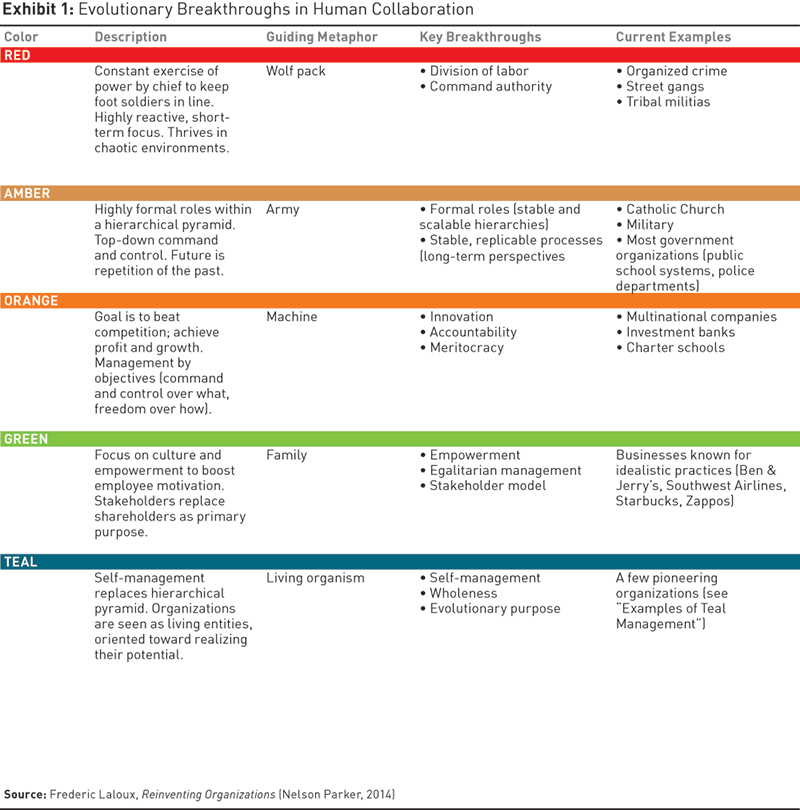
 If you don't know what TEAL is referring to - this is a great article to read by the author of "Reinventing Organizations"