Friday, January 14, 2011

Article I wrote "Social Capital Markets Conference 2010: The Evolution of Money and Meaning" for Green Money Journal

I thoroughly enjoyed this year's Social Capital Markets Conference. I wrote an article about it for Green Money Journal below.


"Social Capital Markets Conference 2010: The Evolution of Money and Meaning"


The very existence of the Social Capital Markets conference, known as SOCAP, says it all - over 1,300 vibrant, excited, inspired, brilliant leaders - philanthropists, social entrepreneurs, venture capitalists, micro-finance entrepreneurs, advisors, and consultants who joined together at San Francisco's Fort Mason in early October. They're all working with investing as a means to create better lives for the world's poor, restore and grow healthy ecosystems, foster social entrepreneurs, local food systems, local businesses, and more. All this was just a glimmer in the eye of SRI investors decades ago. Now, it is a reality.


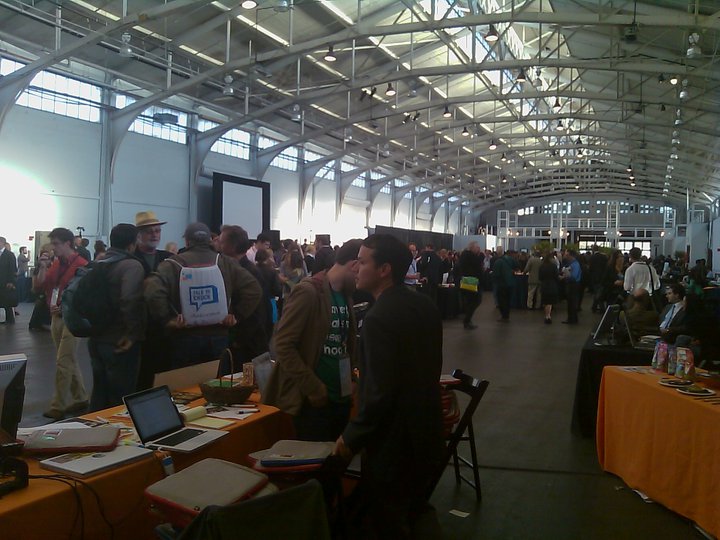
It began this year for me the moment I took a photo of one of the receptions with my phone and posted it with this caption: "Tune in - turn on! Can you feel the Evolution happening? Social Capital Thought Leaders Meta Networking for the Common Good! It's REALLY happening all around the world and a thriving vortex in San Francisco! http://www.socialcapitalmarkets.net "


Estimates are that upwards of $120 billion of investment capital is now available for investments which have meaningful returns, while at the same time address environmental and social woes.


How have things grown, how have things evolved?

There are many areas of development. The meaning of "Capital Market" itself is being explored with innovations like Hoop Fund, where purchass of organic apparel, organic chocolate, quinoa and other foodstuffs are resulting in direct investments in the rural entrepreneurs who produce those products, and the well known micro-finance organization Kiva.org, enabling a global marketplace of people to people investing for good.

The Development of the Impact Investing Space

Impact Investing is a type of Socially Responsible Investing (SRI) that aims to provide environmental or social benefits in addition to economic profit. While the exact size of the Impact Investing market is not known, it is thought to be around $50 billion today, and according to some estimates may reach an astounding $500 billion within the next decade.

Many organizations, including the Rockefeller Foundation, have been part of an effort to create "the basic systems and networks necessary to identify, vet, and monitor investments efficiently"[1]. A comprehensive, dynamic database of the Impact Investing space will be a useful tool for investment advisors in that space who currently rely on a large amount of "one-to-one communication methods" to gather information. Further, those companies seeking investors want a formalized and functioning marketplace to attract capital. The effort is not a small one, and it seems that many smaller efforts have begun to work together. A project created through a Rockefeller Foundation Impact Investment Initiative grantee called the Global Impact Investing Network ( http://www.globalimpactinvestingnetwork.org ) aims to develop the Impact Investing space through a number of initiatives.

These initiatives include:

  • IRIS - Impact Reporting and Investment Standards. Includes specific data points in setting impact standards. Sarah Gelfand is director of the IRIS project. More information about IRIS at: http://www.iris-standards.org 
  • GIIRS - Global Impact Investment Rating System. A rating system similar to Morningstar's on how effective an investment creates an impact in a particular area. The system is being built by B-Lab. 
  • Data Aggregator - "a repository to compile the data points on multitudes of organizations for market comparisons, benchmarking, and other analytics." 
  • PULSE - "a web-based portfolio management software application designed to help money managers track the socially positive impact of investments by plugging directly into the IRIS taxonomy and database." Currently 6 companies are using a beta version, and there will be 150 using the next version soon. Acumen is a principle author along with Salesforce, Google, and App-X.

Partners include: Rockefeller Foundation, Deloitte, PricewaterhouseCoopers, Hitachi, Citigroup, Deutsche Bank, J.P.Morgan, the Bill & Melinda Gates Foundation, Imprint Capital, RSF Social Finance, Calvert Foundation, Acumen, and B-Lab.

GIIRS is a ratings endeavor that provides social and environmental impact ratings for companies and funds seeking to raise capital from impact investors.

The GIIRS community has launched the "Pioneer Funds," a compilation of the leading funds in the space, enabling investors, analysts, and researchers to have a better handle on the core of the movement through what are perceived to be the leading funds representing the scope of impact investing. GIIRS is a project of the non-profit B Lab whose mission is to use the power of business for a better world. More information about GIIRS at http://www.giirs.org/about-giirs/about

Twelve leading North American impact investing funds were announced as GIIRS Pioneer Funds at the conference and thirteen leading emerging market funds were highlighted at the Presidential Summit on Entrepreneurship in April. In sum, the 25 GIIRS Pioneer fund managers represent $1.2 billion in assets under management and have investments in more than 200 high impact companies in over 40 countries. The twelve North American Funds named include City Light, Capital, Core Innovation Capital, Equilibrium Capital, Good Capital, Mindful Investors, Murex Investments, Renewal Partners, RSF Social Finance, Satori Capital, SJF Ventures, SustainVC, and TBL Capital. More information at http://www.giirs.org/for-funds/pioneer

Markets with a Mission

Another effort to make the market of impact investments more transparent and thriving was represented by the launch of Mission Markets, "a financial services company that operates ‘The Impact Investment Platform' supporting the social and environmental capital markets." Mission Markets' unique trading platform, Mission Markets Earth Exchange, includes transactions in environmental commodities such as carbon credits and Renewable Energy Certificates (RECs) as well as Wetland Mitigation and Habitat Credits. In the future, lesser known vehicles including Stormwater Runoff Credits, Mangrove Credits, Biomass Units and Marine Carbon Credits. Mission Markets CEO and Founder Michael Van Patten unveiled his groundbreaking platform during the panel entitled "Mapping the Space: Innovative Markets for Good," and stressed that the company supports both social and environmental markets. More on Mission Markets at http://missionmarkets.com

SOCAP has been kind enough to share videos the insightful panel discussions and keynote speakers from its conferences. To view the "Innovative Markets for Good" panel featuring Michael Van Patten and a demonstration of the Mission Market Earth Exchange, visit:http://video.socialcapitalmarkets.net/2010/10/innovative-markets-for-good-mappin...

Getting Individuals and Families Involved

While much of the Impact Investment space has been limited to institutional investors, the Money for Good report by Hope Consulting includes a number of valuable studies to help unlock the Impact Investing marketplace to all sectors. Their initiative outlines that there marketplace represents nearly $120 billion of retail investors willing to invest in impact investing, with amounts smaller than $100,000.

Their studies also outline important barriers due primarily to the fact that impact investing is still in the early stages. Some of the issues are:

  • Lack of track record 
  • Investors don't know where to find information on Impact Investments 
  • Advisors not recommending Impact Investments 
  • Limited advice available 
  • Insufficient ratings/benchmarks

Also their study identified three major segments of investors with different motivations for impact investing: Safety of investment first. Socially focused, and Quality of organization to be invested in.

In order to move forward to broaden the access for individuals, there are several key factors necessary to be developed: Information and infrastructure, Financial Advisors, Products.

For organizations trying to unlock this market:
A. Clarify what impact investing means
B. Build awareness of impact investing and the opportunities available for investors
C. Develop and disseminate information on impact investing to financial advisors

For all organizations involved in Impact Investing:
D. Structure products with small initial investments (<$25,000)
E. Tailor products and messages by segment, to appeal to different motivations
F. Make opportunities accessible to investors
G. Position these as investments, not as alternatives to charity
H. Address barriers related to the markets' immaturity, which are consistent across segments

Another key point is that in order for Impact Investments to reach the retail marketplace, financial advisors need to be a central part of the equation. Here are the points that Hope Consulting identified.

Majority of respondents used an advisor:

  • #1 source of information for investors 
  • 45% want to transact through their advisor

However, many advisors don't know about these opportunities. And when they do know, they see barriers to recommending them:

  • "There isn't a database with these options" 
  • "I can't find out about them where I find out about other opportunities" 
  • "I am not confident in the track record" 
  • "Where is my upside?"


There are just the highlights of the study, find out more here http://hopeconsulting.us/money-for-good

Shopping the Talk

Another exciting development is the work of Gloria Nelund CEO of TriLinc Global. Her firm's effort is to bring retail investors to the impact investing space based on her years of experience in many different roles in major investment banks:

"TriLinc Global, LLC is the world's first impact investment firm dedicated to harnessing the collective power of main street investors in the United States to help businesses in developing countries create jobs, grow the middle class and generate measurable positive impact. Founded by a team of proven investors and entrepreneurs, TriLinc Global is dedicated to the idea that positive economic growth, social progress and environmental sustainability can and must go hand and hand.

The Company currently operates in the U.S., Latin America and South Asia and invests capital through a series of proprietary funds with a new focus on non-traded SEC registered retail fund vehicles. These vehicles pay a fixed current dividend, offer long-term capital appreciation potential, and produce measurable social and/or environmental impact results."

The Good Pitch

The Good Pitch is a British-based venture that introduces impact filmmakers to parties such as NGOs, foundations, brands, and other potential allies and funders who share a passion for socially inspired films. Among the films pitched was Megan Gelstein's documentary Green Shall Overcome about Van Jones, the former Green Jobs Czar, whose time in Washington was cut short due to some of his "controversial" views. Jones also spoke at the event, sharing stories of his travails as well as his mission to help build a new socially empowering green jobs economy, themes both at the heart of the film. Trailers of the eight films selected for good pitch are available here: http://goodfilm.org/goodpitch/overview

Other Groups and Projects of Note

Social Venture Technology (SVT) Group ( http://www.svtgroup.net ) has published a book called Social Return on Investment: A guide to SROI analysis. Their analysis of the existing methodologies on Impact Investing helped inform the development of IRIS.

According to Investment News, there is another platform being developed called Alternative Investment Product. The platform is being developed by the Depository Trust and Clearing Corp. (DTCC) and is already being utilized by Pershing, and Schwab is testing it. DTCC is hoping that its new platform will become the industry standard. [2]

In London, plans are underway to create a Social Stock Exchange. The exchange would feature companies with a social or environmental purpose, and its creators also hope to eventually attract businesses from the developing world. [3]

The Evolving Social Capital Markets Ecosystem

One brief article cannot cover the myriad conversations, projects, desires, intentions and enthusiasm in the space. And there is more to come. At a recent speech in San Francisco, Secretary of State Hillary Clinton announced SOCAP@State, a joint endeavor with SOCAP and the State Department to take place in Washington, D.C. in 2011. Meanwhile, across the pond, SOCAP Europe runs from May 31 through June 2, 2011 in Amsterdam.

We are making a difference, one dollar, one idea, one intention at a time, for the common good!

To see many of the dynamic and powerful speakers from the past two SOCAP conferences, watch videos here: http://video.socialcapitalmarkets.net

Article References:

[1] Investment strategy - Architects of a ‘social investment data engine'. (2010, April 11). Financial Times. Retrieved June 15, 2010, from http://www.ft.com/cms/s/0/e297b7de-440b-11df-9235-00144feab49a.html

[2] Kelly, B. (2010, June 6). Coming soon: Clarity on alternative investments? Investment News. Retrieved June 15, 2010, fromhttp://www.investmentnews.com/article/20100606/REG/306069981/-1/INIssueAlert01

[3] Social Stock Exchange Could Be 18 Months Away. (2010, April). The Rockefeller Foundation. Retrieved June 23, 2010, from http://www.rockefellerfoundation.org/news/social-stock-exchange-could-be-18-mont...

Article by Gregory Wendt, CFP is the Vice President of Sustainable and Responsible Investing. He is frequently profiled or quoted as an expert in the media including "Living with Ed" Television Show on Home and Garden Television, Business Ethics magazine, Daily Variety, Financial Planning magazine and Yogi Times magazine. Greg speaks regularly at conferences on the matters of new paradigms in economics, sustainable and responsible investing, new consciousness around wealth and related matters. Mr. Wendt is also the co-founder of the non-profit Green Business Networking (http://www.greenbusinessnetworking.org), a community of over 3,500 green business owners and professionals in Los Angeles dedicated to green economy, and the founder/visionary behind Green Economy Think Tank Day (http://www.greeneconomythinktank.org ) an annual conference for LA Region's sustainability leaders. Contact Greg by email at gwendt@epwealth.com.

Special thanks to Mark Sutton who provided research and editorial support for this article. Mark is an Environmental Market Analyst at the San Francisco Carbon Collaborative who share's Greg passion for Impact Investing.

Wednesday, December 08, 2010

Applying "Feminine Values" to guide leadership in Finance

Axioms shared by Fincancier Halla Tomasdottir who helped to rebuild Iceland's financial system after the crash in her TED talk.

(1) Risk Awareness.
(2) Straight Talking. Use Simple Language that people understand.
(3) Emotional Capital. Emotional due diligence is as important as financial due diligence.
(4) Profit With Principles.


"Halla Tomasdottir, an Icelandic fund manager and founder of Audur Capital, a wealth management firm in Reykjavik, is certain that if women had been at the helm of Iceland’s economy and its major banks, the country would not have been brought to its knees."
The Daily Mail, March 28, 2009

Watch Video Here.

Wednesday, December 01, 2010

"Capitalism 2.0: How Big Money is Shifting Corporate Culture Toward Sustainability" Panel I moderated at the Global Summit -

In November 2010, I moderated a panel discussion at The Global Summit conference in San Francisco.

The two panelists were leading thinkers in the sustainability: Andy Behar - CEO of As You Sow Foundation, who's mission is to "To promote corporate responsibility through shareholder advocacy, grantmaking, and innovative legal strategies"

and John Perkins - As Chief Economist at a major international consulting firm, John Perkins advised the World Bank, United Nations, IMF, U.S. Treasury Department, Fortune 500 corporations, and countries in Africa, Asia, Latin America, and the Middle East. He worked directly with heads of state and CEOs of major companies. His books on economics and geo-politics have sold more than 1 million copies, spent many months on the New York Times and other bestseller lists, and are published in over 30 languages.


Here's a link to the video.

Thursday, November 25, 2010

"Fixing the Future" Now. Realities and gifts of new economics models.

I had the pleasure of meeting David Brancaccio at the SRI in the Rockies conference recently where he talked about the manifestations of a new economy. His video documentary on PBS called "Fixing the Future" will give you a better idea of his findings, and I trust give you visions of a new world awaiting us.

Watch the full episode. See more NOW on PBS.

Monday, November 22, 2010

"Of Human Wealth: New Money for a New World" by Bernard Lietaer


Bernard Lietaer's new book "Of Human Wealth: New Money for a New World" outlines a pathway forward for humanity's monetary system.

"We can end the threats to our environment and aid dramatically in its restoration; we can help
provide meaningful work for all, with work that enhances and replenishes the world about us; we can effectively address fundamental urban and rural concerns and assist in the development of viable, sustainable communities; we can care for the sick and the elderly and provide all of our children with adequate shelter, healthcare, nutrition and decent educations.  We can indeed create a better world where life and all living systems flourish. This is not an idealistic dream, but rather, a pragmatic attainment, and achievable within our very own lifetimes."

Sunday, October 31, 2010

"Hazards of Prophecy: Failure of Imagination" Arthur C. Clarke's Three Laws

From Arthur C. Clarke's "Hazards of Prophecy: Failure of Imagination"
I would replace "elderly scientist" with "many people."


  • When a distinguished but elderly scientist states that something is possible, he is almost certainly right. When he states that something is impossible, he is probably wrong.

  • The only way of discovering the limits of the possible is to venture a little way past them into the impossible.

  • Any sufficiently advanced technology is indistinguishable from magic.
  • Wednesday, October 13, 2010

    Monday, August 30, 2010

    How Big Brands can save Biodiversity - 25% of Top 15 commodities controlled by 100 companies

    Jason Clay of World Wildlife Fund says it straight - 25% of the top 15 commodities are controlled by only 100 companies.

    There is massive opportunity for just making these companies shift to sustainable production and supply chains across the key commodities on the planet....

    Watch here:

    Sunday, August 15, 2010

    The Movie Avatar - is actually a documentary for how we have spread our civilization!

    Did you see Avatar? If not, there's no question why it's a blockbuster - one of the most entertaining films I have seen in years.

    Of great interest to many is the story of the film - what it is telling us.

    In India today - a company wants to blow the top off of a Holy Mountain to gain the 70 million tons of bauxite inside of it - and therefore destroy the sacred homeland of the Dongria people who have called this mountain their home  for millenia. Something isn't working here.

    This story is not isolated, it has played out over many generations, the most well known was the how the "conquistadors" - Columbus, etc. "discovered" America.  Our culture's world view and related stories of history taught in our schools continue to allow for this destruction of life by framing the stories and celebrating the destroyers as leaders and heroes.

    Monday, July 05, 2010

    Charles Eisenstein inteview from "Money and Life" Movie

    I deeply appreciate the conscious and insightful perspective which Charles Eisenstein to the conversations of money, value, quality of life and culture. Here's a video of some his thoughts from an upcoming film called "Money and Life"

    Charles Eisenstein Interview for Money & Life Film from Charles Eisenstein on Vimeo.

    Thursday, July 01, 2010

    "Inside Scoop on Green Business Networking" An article about a non-profit I co-founded

    The recent article in Whole Person Calendar "The Inside Scoop on Green Business Networking" covers the group I co-founded in 2006 called "Green Business Networking"


    "Many people are interested in protecting the environment and want to engage in positive “green” business practices. They also want to meet like-minded people who also share similar lifestyles that evolve towards sustainability. But where do “green-minded people” go to network? Others may wonder if networking isn’t really just a disguised excuse to have a few drinks at a bar? GreenYour.com, “your guide to green anything,” has a good primer on how to find green networking events and offers this advice if you are deciding the pros and cons of green networking:

    On the prowl for an eco-job? Recruiting for a conservation project in the community? Simply looking to connect and converse with like-minded folk? If you responded “yes” to any of the above queries, attending a green business networking event may be the solution."
    Read the entire article here. 

    Sunday, June 06, 2010

    Ostrich, Musical Chairs or Plan B

    My friend Leslie Christian of Portfolio 21 Investments wrote an excellent piece in the "Reimagine Money" blog from RSF Social Finance. The post is on assessing our own views on how to deal with the ecological limits of our economic growth.

    She writes:  "As you think about your own response to risk, it’s unlikely that you will jump immediately from ecological limits to how much you should invest in stocks versus bonds versus real estate. It’s more likely that your responses fit into one or more of the following categories. You’ll notice that the risk responses below do not explicitly deal with investing, much less with traditional asset classes. Rather, they provide a way to examine your personal tendencies for dealing with risk, which is an essential precursor to forming an intelligent, risk-based investment strategy."

    I agree, every time I discuss a situation with a client I do my best to assess how they feel about their response to risk.

    She goes on to describe three different responses to risk: the ostrich approach, musical chairs or plan b.

    Read her entire article here.

    Friday, May 07, 2010

    Growing slow money - a video from the slow money alliance

    My friend Woody Tasch is changing the world of money with his "Slow Money Alliance".

    Here's a video from his effort to give you an idea of what it's all about:

    Tuesday, May 04, 2010

    Why does a hamburger cost less than a salad?


    NY Times article discusses food subsidies as rationale why our food costs are not in line with nutrition.

    John Perkins - Shapeshifting Corporate Culture To A Sustainable Thriving World

    Reality Sandwich just published a wonderful interview with John Perkins - author of the best selling book - "Confessions of an Economic Hitman."  In the interview he points to the opportunity, and responsibility we have to shift our global corporations to ensuring well being for all of Earth's inhabitants.

    The interview finishes with an important opportunity:
    Perkins states:


    "Imagine if a number of us had the dream that Coca-Cola, McDonald's and Nike all committed to making sure that nobody in the world ever goes without sufficient water, food, or clothes. If we had that vision, we would tell those companies, look, we're never going to buy anything more from you until you do this.
    Coca-Cola is like Godzilla. Can you really see it responding to these kinds of demands?
    Immediately following the tsunami last winter, Coca-Cola sent millions of bottles of water to the victims. But every day 24,000 people in the world die of thirst. and starvation. You don't have to wait for a tsunami—there is a much bigger tragedy. If people have that vision and begin to act upon it, I guarantee you that Coca-Cola will change, and if Coca-Cola changes, then Pepsi Cola will have to change too. And everybody else."

    Thursday, April 29, 2010

    Goldman v. United States: What It Means

    "It is not what a lawyer tells me I may do, but what humanity, reason and justice tell me I ought to do." - Edmund Burke, statesman, philosopher  

    My friend John Fullerton a 20 year Investment Banker from JP Morgan just wrote a must-read piece on the recent Goldman Sachs issues of conflict of interest, and the resultant SEC Lawsuit.
                     
    John's last sentence sentence sums up my views on the need to rewrite the source code of financial system.
    "There is much hard work ahead in creating a resilient and trusted financial system that serves the needs of the real economy rather than the self-interest of a few.  More importantly, finance must evolve so it can fuel the transition of the real economy to respond to the injustice of gross and increasing wealth inequality, and, for the first time, to intelligently acknowledge the finite boundaries of the ecosystem that are in conflict with the finance driven global economy’s never ending growth of material throughput." 

    Sunday, April 25, 2010

    Many of America's Foods are killing it's people.

    We need a new economic system that incorporates caring for each other and nature.

    "Economic systems are human creations. Every economic institution and program, from banks and corporations to unemployment insurance and Social Security, is a human invention.  The economic rules we we take for granted are human inventions.  We must decide which economic rules we want to keep and which we want to leave behind, and invent new economic rules that meet our authentic human needs.  If we join together to demand these new rules, we can each play a part in moving toward a more caring economics and a more caring world."

    From "Real Wealth Of Nations" by Riane Eisler.

    Friday, April 02, 2010

    SUSTAINABLE AND RESPONSIBLE INVESTING: How Your Money Can Help You and the World

    This is an article I just wrote for Whole Person Calendar.

    "Sustainable And Responsible Investing: How Your Money Can Help You and The World"
    You can view the article PDF here.

    In the past few years, our financial system has been rocked to its core. Belief in profit-driven motives as the sole metrics of perfor-mance has been fundamentally shaken. Our perception of risk have been forever altered, and our economy is shifting toward a new foundation. Traditionally, investments are made with one, and only one, measure in mind -- how much money does the invest-ment return? Every investment is consid-ered for its financial return potential, yet fi-nancial return should not be the only metric for success. In today’s world, investing pro-cesses must take into consideration the im-pact on the environment, the individuals employed, the communities involved, the climate, biodiversity issues, and a host of other factors.

    One of my clients, Terrie, is an anti-tobacco educator for colleges across California. She’s devoted to her job and has a talent for helping young people recognize the perils of smoking. That’s why she was appalled when she learned that every one of her mutual funds held large investments in tobacco stocks. For Terrie, the revelation that her investment portfolio conflicted with her personal values is what sent her to my office and marked the beginning of her interest and inquiry in socially and environmentally responsible investing. Another client of mine, Mary, is pleased that now her “mon-ey is where her mouth is.” Mary, a successful television actress, is very active in supporting environmental groups and progressive causes. For years, her advisor was a family stockbroker at a major brokerage firm. On a number of occasions, she raised her concerns about companies in her portfolio that depleted natural resources and befouled the earth. Mary encouraged her advisor to find investments and mutual funds that were socially and environmentally responsible. Throughout the relationship, the broker derided her concerns; he dismissed such requests and advised her that sustainable and respon-sible investment strategies were inferior. Eventually Mary got fed up. She came to me seeking someone who would not only listen to her concerns, but also help her to earn competitive returns on her portfolio. Mary says she is pleased that her wealth is not only growing, but it is also helping to fuel positive change in the in corporate America and having an impact through community development investments she has made. Her investments, she says, are now safeguarding her family’s welfare – and the planet’s.

    Mary and Terrie aren’t alone. The trend toward sustainable investing, also known as socially responsible investing (SRI), began in the 1960s, as people began to shun companies like Dow Chemical that profited from the manufacture of napalm for the Vietnam War. The movement to sell off “sin stocks” gained momentum in the 1980s. A growing number of investors found it unconsciona-ble to hold stocks in companies that did business in apartheid South Africa. Success with helping to end apartheid inspired socially responsible investors to turn their attention to other issues, such as protecting the environment and promoting fair labor practices. One faith-based institutional investor on the East coast, alone, leverages its $90 billion in assets to make better corporate citizens out of companies as large and powerful as Exxon Mobil, Chevron and General Electric.

    Today, one out of every eight dollars under professional management in the U.S. is part of a values-based portfolio. In 2007, the Social Investment Forum reported that socially responsible invest-ments in the U.S. totaled more than $2.71 trillion in total assets under management using one or more of the three core socially responsible investing strategies—screening, shareholder advocacy, and community investing. About one out of every ten dollars under professional management in the United States today is involved in socially responsible investing—11 percent of the $25.1 trillion in total assets under management.

    How Can I Become A Socially Responsible Investor