Friday, January 14, 2011

Article I wrote "Social Capital Markets Conference 2010: The Evolution of Money and Meaning" for Green Money Journal

I thoroughly enjoyed this year's Social Capital Markets Conference. I wrote an article about it for Green Money Journal below.


"Social Capital Markets Conference 2010: The Evolution of Money and Meaning"


The very existence of the Social Capital Markets conference, known as SOCAP, says it all - over 1,300 vibrant, excited, inspired, brilliant leaders - philanthropists, social entrepreneurs, venture capitalists, micro-finance entrepreneurs, advisors, and consultants who joined together at San Francisco's Fort Mason in early October. They're all working with investing as a means to create better lives for the world's poor, restore and grow healthy ecosystems, foster social entrepreneurs, local food systems, local businesses, and more. All this was just a glimmer in the eye of SRI investors decades ago. Now, it is a reality.


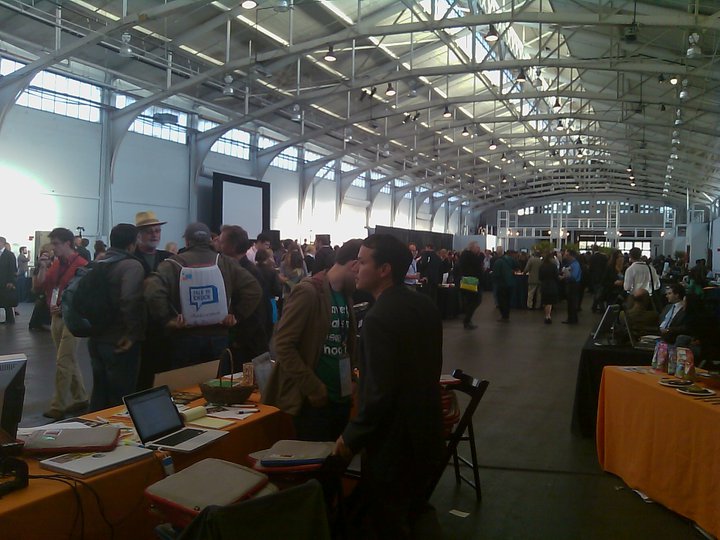
It began this year for me the moment I took a photo of one of the receptions with my phone and posted it with this caption: "Tune in - turn on! Can you feel the Evolution happening? Social Capital Thought Leaders Meta Networking for the Common Good! It's REALLY happening all around the world and a thriving vortex in San Francisco! http://www.socialcapitalmarkets.net "


Estimates are that upwards of $120 billion of investment capital is now available for investments which have meaningful returns, while at the same time address environmental and social woes.


How have things grown, how have things evolved?

There are many areas of development. The meaning of "Capital Market" itself is being explored with innovations like Hoop Fund, where purchass of organic apparel, organic chocolate, quinoa and other foodstuffs are resulting in direct investments in the rural entrepreneurs who produce those products, and the well known micro-finance organization Kiva.org, enabling a global marketplace of people to people investing for good.

The Development of the Impact Investing Space

Impact Investing is a type of Socially Responsible Investing (SRI) that aims to provide environmental or social benefits in addition to economic profit. While the exact size of the Impact Investing market is not known, it is thought to be around $50 billion today, and according to some estimates may reach an astounding $500 billion within the next decade.

Many organizations, including the Rockefeller Foundation, have been part of an effort to create "the basic systems and networks necessary to identify, vet, and monitor investments efficiently"[1]. A comprehensive, dynamic database of the Impact Investing space will be a useful tool for investment advisors in that space who currently rely on a large amount of "one-to-one communication methods" to gather information. Further, those companies seeking investors want a formalized and functioning marketplace to attract capital. The effort is not a small one, and it seems that many smaller efforts have begun to work together. A project created through a Rockefeller Foundation Impact Investment Initiative grantee called the Global Impact Investing Network ( http://www.globalimpactinvestingnetwork.org ) aims to develop the Impact Investing space through a number of initiatives.

These initiatives include:

  • IRIS - Impact Reporting and Investment Standards. Includes specific data points in setting impact standards. Sarah Gelfand is director of the IRIS project. More information about IRIS at: http://www.iris-standards.org 
  • GIIRS - Global Impact Investment Rating System. A rating system similar to Morningstar's on how effective an investment creates an impact in a particular area. The system is being built by B-Lab. 
  • Data Aggregator - "a repository to compile the data points on multitudes of organizations for market comparisons, benchmarking, and other analytics." 
  • PULSE - "a web-based portfolio management software application designed to help money managers track the socially positive impact of investments by plugging directly into the IRIS taxonomy and database." Currently 6 companies are using a beta version, and there will be 150 using the next version soon. Acumen is a principle author along with Salesforce, Google, and App-X.

Partners include: Rockefeller Foundation, Deloitte, PricewaterhouseCoopers, Hitachi, Citigroup, Deutsche Bank, J.P.Morgan, the Bill & Melinda Gates Foundation, Imprint Capital, RSF Social Finance, Calvert Foundation, Acumen, and B-Lab.

GIIRS is a ratings endeavor that provides social and environmental impact ratings for companies and funds seeking to raise capital from impact investors.

The GIIRS community has launched the "Pioneer Funds," a compilation of the leading funds in the space, enabling investors, analysts, and researchers to have a better handle on the core of the movement through what are perceived to be the leading funds representing the scope of impact investing. GIIRS is a project of the non-profit B Lab whose mission is to use the power of business for a better world. More information about GIIRS at http://www.giirs.org/about-giirs/about

Twelve leading North American impact investing funds were announced as GIIRS Pioneer Funds at the conference and thirteen leading emerging market funds were highlighted at the Presidential Summit on Entrepreneurship in April. In sum, the 25 GIIRS Pioneer fund managers represent $1.2 billion in assets under management and have investments in more than 200 high impact companies in over 40 countries. The twelve North American Funds named include City Light, Capital, Core Innovation Capital, Equilibrium Capital, Good Capital, Mindful Investors, Murex Investments, Renewal Partners, RSF Social Finance, Satori Capital, SJF Ventures, SustainVC, and TBL Capital. More information at http://www.giirs.org/for-funds/pioneer

Markets with a Mission

Another effort to make the market of impact investments more transparent and thriving was represented by the launch of Mission Markets, "a financial services company that operates ‘The Impact Investment Platform' supporting the social and environmental capital markets." Mission Markets' unique trading platform, Mission Markets Earth Exchange, includes transactions in environmental commodities such as carbon credits and Renewable Energy Certificates (RECs) as well as Wetland Mitigation and Habitat Credits. In the future, lesser known vehicles including Stormwater Runoff Credits, Mangrove Credits, Biomass Units and Marine Carbon Credits. Mission Markets CEO and Founder Michael Van Patten unveiled his groundbreaking platform during the panel entitled "Mapping the Space: Innovative Markets for Good," and stressed that the company supports both social and environmental markets. More on Mission Markets at http://missionmarkets.com

SOCAP has been kind enough to share videos the insightful panel discussions and keynote speakers from its conferences. To view the "Innovative Markets for Good" panel featuring Michael Van Patten and a demonstration of the Mission Market Earth Exchange, visit:http://video.socialcapitalmarkets.net/2010/10/innovative-markets-for-good-mappin...

Getting Individuals and Families Involved

While much of the Impact Investment space has been limited to institutional investors, the Money for Good report by Hope Consulting includes a number of valuable studies to help unlock the Impact Investing marketplace to all sectors. Their initiative outlines that there marketplace represents nearly $120 billion of retail investors willing to invest in impact investing, with amounts smaller than $100,000.

Their studies also outline important barriers due primarily to the fact that impact investing is still in the early stages. Some of the issues are:

  • Lack of track record 
  • Investors don't know where to find information on Impact Investments 
  • Advisors not recommending Impact Investments 
  • Limited advice available 
  • Insufficient ratings/benchmarks

Also their study identified three major segments of investors with different motivations for impact investing: Safety of investment first. Socially focused, and Quality of organization to be invested in.

In order to move forward to broaden the access for individuals, there are several key factors necessary to be developed: Information and infrastructure, Financial Advisors, Products.

For organizations trying to unlock this market:
A. Clarify what impact investing means
B. Build awareness of impact investing and the opportunities available for investors
C. Develop and disseminate information on impact investing to financial advisors

For all organizations involved in Impact Investing:
D. Structure products with small initial investments (<$25,000)
E. Tailor products and messages by segment, to appeal to different motivations
F. Make opportunities accessible to investors
G. Position these as investments, not as alternatives to charity
H. Address barriers related to the markets' immaturity, which are consistent across segments

Another key point is that in order for Impact Investments to reach the retail marketplace, financial advisors need to be a central part of the equation. Here are the points that Hope Consulting identified.

Majority of respondents used an advisor:

  • #1 source of information for investors 
  • 45% want to transact through their advisor

However, many advisors don't know about these opportunities. And when they do know, they see barriers to recommending them:

  • "There isn't a database with these options" 
  • "I can't find out about them where I find out about other opportunities" 
  • "I am not confident in the track record" 
  • "Where is my upside?"


There are just the highlights of the study, find out more here http://hopeconsulting.us/money-for-good

Shopping the Talk

Another exciting development is the work of Gloria Nelund CEO of TriLinc Global. Her firm's effort is to bring retail investors to the impact investing space based on her years of experience in many different roles in major investment banks:

"TriLinc Global, LLC is the world's first impact investment firm dedicated to harnessing the collective power of main street investors in the United States to help businesses in developing countries create jobs, grow the middle class and generate measurable positive impact. Founded by a team of proven investors and entrepreneurs, TriLinc Global is dedicated to the idea that positive economic growth, social progress and environmental sustainability can and must go hand and hand.

The Company currently operates in the U.S., Latin America and South Asia and invests capital through a series of proprietary funds with a new focus on non-traded SEC registered retail fund vehicles. These vehicles pay a fixed current dividend, offer long-term capital appreciation potential, and produce measurable social and/or environmental impact results."

The Good Pitch

The Good Pitch is a British-based venture that introduces impact filmmakers to parties such as NGOs, foundations, brands, and other potential allies and funders who share a passion for socially inspired films. Among the films pitched was Megan Gelstein's documentary Green Shall Overcome about Van Jones, the former Green Jobs Czar, whose time in Washington was cut short due to some of his "controversial" views. Jones also spoke at the event, sharing stories of his travails as well as his mission to help build a new socially empowering green jobs economy, themes both at the heart of the film. Trailers of the eight films selected for good pitch are available here: http://goodfilm.org/goodpitch/overview

Other Groups and Projects of Note

Social Venture Technology (SVT) Group ( http://www.svtgroup.net ) has published a book called Social Return on Investment: A guide to SROI analysis. Their analysis of the existing methodologies on Impact Investing helped inform the development of IRIS.

According to Investment News, there is another platform being developed called Alternative Investment Product. The platform is being developed by the Depository Trust and Clearing Corp. (DTCC) and is already being utilized by Pershing, and Schwab is testing it. DTCC is hoping that its new platform will become the industry standard. [2]

In London, plans are underway to create a Social Stock Exchange. The exchange would feature companies with a social or environmental purpose, and its creators also hope to eventually attract businesses from the developing world. [3]

The Evolving Social Capital Markets Ecosystem

One brief article cannot cover the myriad conversations, projects, desires, intentions and enthusiasm in the space. And there is more to come. At a recent speech in San Francisco, Secretary of State Hillary Clinton announced SOCAP@State, a joint endeavor with SOCAP and the State Department to take place in Washington, D.C. in 2011. Meanwhile, across the pond, SOCAP Europe runs from May 31 through June 2, 2011 in Amsterdam.

We are making a difference, one dollar, one idea, one intention at a time, for the common good!

To see many of the dynamic and powerful speakers from the past two SOCAP conferences, watch videos here: http://video.socialcapitalmarkets.net

Article References:

[1] Investment strategy - Architects of a ‘social investment data engine'. (2010, April 11). Financial Times. Retrieved June 15, 2010, from http://www.ft.com/cms/s/0/e297b7de-440b-11df-9235-00144feab49a.html

[2] Kelly, B. (2010, June 6). Coming soon: Clarity on alternative investments? Investment News. Retrieved June 15, 2010, fromhttp://www.investmentnews.com/article/20100606/REG/306069981/-1/INIssueAlert01

[3] Social Stock Exchange Could Be 18 Months Away. (2010, April). The Rockefeller Foundation. Retrieved June 23, 2010, from http://www.rockefellerfoundation.org/news/social-stock-exchange-could-be-18-mont...

Article by Gregory Wendt, CFP is the Vice President of Sustainable and Responsible Investing. He is frequently profiled or quoted as an expert in the media including "Living with Ed" Television Show on Home and Garden Television, Business Ethics magazine, Daily Variety, Financial Planning magazine and Yogi Times magazine. Greg speaks regularly at conferences on the matters of new paradigms in economics, sustainable and responsible investing, new consciousness around wealth and related matters. Mr. Wendt is also the co-founder of the non-profit Green Business Networking (http://www.greenbusinessnetworking.org), a community of over 3,500 green business owners and professionals in Los Angeles dedicated to green economy, and the founder/visionary behind Green Economy Think Tank Day (http://www.greeneconomythinktank.org ) an annual conference for LA Region's sustainability leaders. Contact Greg by email at gwendt@epwealth.com.

Special thanks to Mark Sutton who provided research and editorial support for this article. Mark is an Environmental Market Analyst at the San Francisco Carbon Collaborative who share's Greg passion for Impact Investing.

Wednesday, December 08, 2010

Applying "Feminine Values" to guide leadership in Finance

Axioms shared by Fincancier Halla Tomasdottir who helped to rebuild Iceland's financial system after the crash in her TED talk.

(1) Risk Awareness.
(2) Straight Talking. Use Simple Language that people understand.
(3) Emotional Capital. Emotional due diligence is as important as financial due diligence.
(4) Profit With Principles.


"Halla Tomasdottir, an Icelandic fund manager and founder of Audur Capital, a wealth management firm in Reykjavik, is certain that if women had been at the helm of Iceland’s economy and its major banks, the country would not have been brought to its knees."
The Daily Mail, March 28, 2009

Watch Video Here.

Wednesday, December 01, 2010

"Capitalism 2.0: How Big Money is Shifting Corporate Culture Toward Sustainability" Panel I moderated at the Global Summit -

In November 2010, I moderated a panel discussion at The Global Summit conference in San Francisco.

The two panelists were leading thinkers in the sustainability: Andy Behar - CEO of As You Sow Foundation, who's mission is to "To promote corporate responsibility through shareholder advocacy, grantmaking, and innovative legal strategies"

and John Perkins - As Chief Economist at a major international consulting firm, John Perkins advised the World Bank, United Nations, IMF, U.S. Treasury Department, Fortune 500 corporations, and countries in Africa, Asia, Latin America, and the Middle East. He worked directly with heads of state and CEOs of major companies. His books on economics and geo-politics have sold more than 1 million copies, spent many months on the New York Times and other bestseller lists, and are published in over 30 languages.


Here's a link to the video.

Thursday, November 25, 2010

"Fixing the Future" Now. Realities and gifts of new economics models.

I had the pleasure of meeting David Brancaccio at the SRI in the Rockies conference recently where he talked about the manifestations of a new economy. His video documentary on PBS called "Fixing the Future" will give you a better idea of his findings, and I trust give you visions of a new world awaiting us.

Watch the full episode. See more NOW on PBS.

Monday, November 22, 2010

"Of Human Wealth: New Money for a New World" by Bernard Lietaer


Bernard Lietaer's new book "Of Human Wealth: New Money for a New World" outlines a pathway forward for humanity's monetary system.

"We can end the threats to our environment and aid dramatically in its restoration; we can help
provide meaningful work for all, with work that enhances and replenishes the world about us; we can effectively address fundamental urban and rural concerns and assist in the development of viable, sustainable communities; we can care for the sick and the elderly and provide all of our children with adequate shelter, healthcare, nutrition and decent educations.  We can indeed create a better world where life and all living systems flourish. This is not an idealistic dream, but rather, a pragmatic attainment, and achievable within our very own lifetimes."

Sunday, October 31, 2010

"Hazards of Prophecy: Failure of Imagination" Arthur C. Clarke's Three Laws

From Arthur C. Clarke's "Hazards of Prophecy: Failure of Imagination"
I would replace "elderly scientist" with "many people."


  • When a distinguished but elderly scientist states that something is possible, he is almost certainly right. When he states that something is impossible, he is probably wrong.

  • The only way of discovering the limits of the possible is to venture a little way past them into the impossible.

  • Any sufficiently advanced technology is indistinguishable from magic.
  • Wednesday, October 13, 2010

    Monday, August 30, 2010

    How Big Brands can save Biodiversity - 25% of Top 15 commodities controlled by 100 companies

    Jason Clay of World Wildlife Fund says it straight - 25% of the top 15 commodities are controlled by only 100 companies.

    There is massive opportunity for just making these companies shift to sustainable production and supply chains across the key commodities on the planet....

    Watch here:

    Sunday, August 15, 2010

    The Movie Avatar - is actually a documentary for how we have spread our civilization!

    Did you see Avatar? If not, there's no question why it's a blockbuster - one of the most entertaining films I have seen in years.

    Of great interest to many is the story of the film - what it is telling us.

    In India today - a company wants to blow the top off of a Holy Mountain to gain the 70 million tons of bauxite inside of it - and therefore destroy the sacred homeland of the Dongria people who have called this mountain their home  for millenia. Something isn't working here.

    This story is not isolated, it has played out over many generations, the most well known was the how the "conquistadors" - Columbus, etc. "discovered" America.  Our culture's world view and related stories of history taught in our schools continue to allow for this destruction of life by framing the stories and celebrating the destroyers as leaders and heroes.

    Monday, July 05, 2010

    Charles Eisenstein inteview from "Money and Life" Movie

    I deeply appreciate the conscious and insightful perspective which Charles Eisenstein to the conversations of money, value, quality of life and culture. Here's a video of some his thoughts from an upcoming film called "Money and Life"

    Charles Eisenstein Interview for Money & Life Film from Charles Eisenstein on Vimeo.

    Thursday, July 01, 2010

    "Inside Scoop on Green Business Networking" An article about a non-profit I co-founded

    The recent article in Whole Person Calendar "The Inside Scoop on Green Business Networking" covers the group I co-founded in 2006 called "Green Business Networking"


    "Many people are interested in protecting the environment and want to engage in positive “green” business practices. They also want to meet like-minded people who also share similar lifestyles that evolve towards sustainability. But where do “green-minded people” go to network? Others may wonder if networking isn’t really just a disguised excuse to have a few drinks at a bar? GreenYour.com, “your guide to green anything,” has a good primer on how to find green networking events and offers this advice if you are deciding the pros and cons of green networking:

    On the prowl for an eco-job? Recruiting for a conservation project in the community? Simply looking to connect and converse with like-minded folk? If you responded “yes” to any of the above queries, attending a green business networking event may be the solution."
    Read the entire article here. 

    Sunday, June 06, 2010

    Ostrich, Musical Chairs or Plan B

    My friend Leslie Christian of Portfolio 21 Investments wrote an excellent piece in the "Reimagine Money" blog from RSF Social Finance. The post is on assessing our own views on how to deal with the ecological limits of our economic growth.

    She writes:  "As you think about your own response to risk, it’s unlikely that you will jump immediately from ecological limits to how much you should invest in stocks versus bonds versus real estate. It’s more likely that your responses fit into one or more of the following categories. You’ll notice that the risk responses below do not explicitly deal with investing, much less with traditional asset classes. Rather, they provide a way to examine your personal tendencies for dealing with risk, which is an essential precursor to forming an intelligent, risk-based investment strategy."

    I agree, every time I discuss a situation with a client I do my best to assess how they feel about their response to risk.

    She goes on to describe three different responses to risk: the ostrich approach, musical chairs or plan b.

    Read her entire article here.

    Friday, May 07, 2010

    Growing slow money - a video from the slow money alliance

    My friend Woody Tasch is changing the world of money with his "Slow Money Alliance".

    Here's a video from his effort to give you an idea of what it's all about:

    Tuesday, May 04, 2010

    Why does a hamburger cost less than a salad?


    NY Times article discusses food subsidies as rationale why our food costs are not in line with nutrition.

    John Perkins - Shapeshifting Corporate Culture To A Sustainable Thriving World

    Reality Sandwich just published a wonderful interview with John Perkins - author of the best selling book - "Confessions of an Economic Hitman."  In the interview he points to the opportunity, and responsibility we have to shift our global corporations to ensuring well being for all of Earth's inhabitants.

    The interview finishes with an important opportunity:
    Perkins states:


    "Imagine if a number of us had the dream that Coca-Cola, McDonald's and Nike all committed to making sure that nobody in the world ever goes without sufficient water, food, or clothes. If we had that vision, we would tell those companies, look, we're never going to buy anything more from you until you do this.
    Coca-Cola is like Godzilla. Can you really see it responding to these kinds of demands?
    Immediately following the tsunami last winter, Coca-Cola sent millions of bottles of water to the victims. But every day 24,000 people in the world die of thirst. and starvation. You don't have to wait for a tsunami—there is a much bigger tragedy. If people have that vision and begin to act upon it, I guarantee you that Coca-Cola will change, and if Coca-Cola changes, then Pepsi Cola will have to change too. And everybody else."

    Thursday, April 29, 2010

    Goldman v. United States: What It Means

    "It is not what a lawyer tells me I may do, but what humanity, reason and justice tell me I ought to do." - Edmund Burke, statesman, philosopher  

    My friend John Fullerton a 20 year Investment Banker from JP Morgan just wrote a must-read piece on the recent Goldman Sachs issues of conflict of interest, and the resultant SEC Lawsuit.
                     
    John's last sentence sentence sums up my views on the need to rewrite the source code of financial system.
    "There is much hard work ahead in creating a resilient and trusted financial system that serves the needs of the real economy rather than the self-interest of a few.  More importantly, finance must evolve so it can fuel the transition of the real economy to respond to the injustice of gross and increasing wealth inequality, and, for the first time, to intelligently acknowledge the finite boundaries of the ecosystem that are in conflict with the finance driven global economy’s never ending growth of material throughput." 

    Sunday, April 25, 2010

    Many of America's Foods are killing it's people.

    We need a new economic system that incorporates caring for each other and nature.

    "Economic systems are human creations. Every economic institution and program, from banks and corporations to unemployment insurance and Social Security, is a human invention.  The economic rules we we take for granted are human inventions.  We must decide which economic rules we want to keep and which we want to leave behind, and invent new economic rules that meet our authentic human needs.  If we join together to demand these new rules, we can each play a part in moving toward a more caring economics and a more caring world."

    From "Real Wealth Of Nations" by Riane Eisler.

    Friday, April 02, 2010

    SUSTAINABLE AND RESPONSIBLE INVESTING: How Your Money Can Help You and the World

    This is an article I just wrote for Whole Person Calendar.

    "Sustainable And Responsible Investing: How Your Money Can Help You and The World"
    You can view the article PDF here.

    In the past few years, our financial system has been rocked to its core. Belief in profit-driven motives as the sole metrics of perfor-mance has been fundamentally shaken. Our perception of risk have been forever altered, and our economy is shifting toward a new foundation. Traditionally, investments are made with one, and only one, measure in mind -- how much money does the invest-ment return? Every investment is consid-ered for its financial return potential, yet fi-nancial return should not be the only metric for success. In today’s world, investing pro-cesses must take into consideration the im-pact on the environment, the individuals employed, the communities involved, the climate, biodiversity issues, and a host of other factors.

    One of my clients, Terrie, is an anti-tobacco educator for colleges across California. She’s devoted to her job and has a talent for helping young people recognize the perils of smoking. That’s why she was appalled when she learned that every one of her mutual funds held large investments in tobacco stocks. For Terrie, the revelation that her investment portfolio conflicted with her personal values is what sent her to my office and marked the beginning of her interest and inquiry in socially and environmentally responsible investing. Another client of mine, Mary, is pleased that now her “mon-ey is where her mouth is.” Mary, a successful television actress, is very active in supporting environmental groups and progressive causes. For years, her advisor was a family stockbroker at a major brokerage firm. On a number of occasions, she raised her concerns about companies in her portfolio that depleted natural resources and befouled the earth. Mary encouraged her advisor to find investments and mutual funds that were socially and environmentally responsible. Throughout the relationship, the broker derided her concerns; he dismissed such requests and advised her that sustainable and respon-sible investment strategies were inferior. Eventually Mary got fed up. She came to me seeking someone who would not only listen to her concerns, but also help her to earn competitive returns on her portfolio. Mary says she is pleased that her wealth is not only growing, but it is also helping to fuel positive change in the in corporate America and having an impact through community development investments she has made. Her investments, she says, are now safeguarding her family’s welfare – and the planet’s.

    Mary and Terrie aren’t alone. The trend toward sustainable investing, also known as socially responsible investing (SRI), began in the 1960s, as people began to shun companies like Dow Chemical that profited from the manufacture of napalm for the Vietnam War. The movement to sell off “sin stocks” gained momentum in the 1980s. A growing number of investors found it unconsciona-ble to hold stocks in companies that did business in apartheid South Africa. Success with helping to end apartheid inspired socially responsible investors to turn their attention to other issues, such as protecting the environment and promoting fair labor practices. One faith-based institutional investor on the East coast, alone, leverages its $90 billion in assets to make better corporate citizens out of companies as large and powerful as Exxon Mobil, Chevron and General Electric.

    Today, one out of every eight dollars under professional management in the U.S. is part of a values-based portfolio. In 2007, the Social Investment Forum reported that socially responsible invest-ments in the U.S. totaled more than $2.71 trillion in total assets under management using one or more of the three core socially responsible investing strategies—screening, shareholder advocacy, and community investing. About one out of every ten dollars under professional management in the United States today is involved in socially responsible investing—11 percent of the $25.1 trillion in total assets under management.

    How Can I Become A Socially Responsible Investor


    Thursday, March 25, 2010

    Wanna make a 79% return? Check out Grassland Ecosystem Restoration...


    I first heard of the term "ecosystem services" in the groundbreaking book "Natural Capitalism - Creating the Next Industrial Revolution" by Hunter Lovins, Paul Hawken and Amory Lovins. Essentially the concept is that ecosystems provide tangible value to the global economy far greater in scope and economic value than the economy itself.

    I just came across an article on Science Daily which references a study which actually tallies the potential rate of return on investing in restoring particular ecosystems.

    This is truly next level for me, as the concept of actually MAKING MONEY while RESTORING ECOSYSTEMS is very, very sexy indeed.

    The article states:
    "Experts concluding the global DIVERSITAS biodiversity conference in Cape Town described preliminary research revealing jaw-dropping dollar values of the "ecosystem services" of biomes like forests and coral reefs -- including food, pollution treatment and climate regulation. Undertaken to help societies make better-informed choices, the economic research shows a single hectare of coral reef, for example, provides annual services to humans valued at US $130,000 on average, rising to as much as $1.2 million."


    The article cites estimated return estimates from such investments in various ecosystems:

    "•Coral reefs: 7%, (with a cost-benefit ratio of 2.8);
    •Rivers: 27%, (cost-benefit ratio 15.5);
    •Tropical forests: 50% (cost-benefit ratio 37.3);
    •Mangroves: 40%, (cost-benefit ratio 26.4);
    •Grasslands: 79%, (cost-benefit ratio 75.1)."


    If we could spur an investment gold rush into such endeavors to restore and actually expand such ecosystems we'd see a revolution in the church of money.

    Imagine - greedy Wall Street Executives clamoring over eachother to restore more and more ecosystems. Now that is the closest thing as a good use for greed if I ever saw one.

    Wednesday, March 24, 2010

    More green jobs per million...


    I got this chart from my friend Andy Lipkis' blog, created by University of Massachusets at Amherst. It simply speaks for itself. Green Industry creates more jobs per million dollars invested...

    Thursday, March 11, 2010

    This is how economics should work - regenerative ecological systems for economic gain!

    An ecological network for economic gain. A fish farm and bird sanctuary!

    Our bread basket is threatened by a systemic liquidation of natural resources. We can create world where every community can feed it self.

    Farms that restore ecosystems rather than destroy.

    Farmers experts in relationships.

    Wednesday, February 17, 2010

    A Vegan in a Hummer?


    Many enviros simply want change, as long as they don't have to change their lifestyle very much.

    I know this from experience, my own! Admittedly - this green guy still could do more.

    Yet the smartest people I know are aware that our happiness is built on lifelong journey of learning. Ray Anderson's book "Midcourse Correction" is a testament to that sage wisdom applied in business.

    There's a movement afoot in the MIT Circles -

    Smart managers are wary of epiphanies. “Suddenly, everything looked different” should be the last line of a short story, not a report from the management front. But sometimes, something makes you look at a matter you’ve paid a lot of attention to in a different way. Even if you look at everything differently for only a moment and then you return to your original perspective, that perspective has been changed.That may have happened to some people at last week’s Pop!Tech conference, in Camden, Maine. One of the speakers was Michael Pollan, author of The Botany of Desire, who delivered a variation of his standard talk on sustainable food. In that talk, he dropped this nugget:

    “A vegan in a Hummer has a lighter carbon footprint than a beef eater in a Prius.”

    Read the entire article here.

    “A vegan in a Hummer has a lighter carbon footprint than a beef eater in a Prius.”

    Friday, January 08, 2010

    Article I wrote for Triplepundit.com - Economics Built on Beauty and Community

    I wrote an article last fall for Triple Pundit:

    Right before I boarded a plane recently, I noticed a Body Shop in the terminal next to the gate. The Body Shop has been a leading business that incorporates social and environmental values into its operations. It was founded by the late Anita Roddick, one of the emergent leaders in the expanding and evolving “green” business movement.

    Roddick was a very influential and inspiring thought leader, she stood as a pillar of the socially and environmentally responsible business movement. As I thumbed through my reading materials I found an article in Resurgence Magazine by Roddick entitled “The Currency of Imagination.” This eloquent article laid out some of her guiding principles and reflections on being one of the only CEOs (if not the only CEO) in the crowd of human beings who raised their voices against the globalization paradigm represented by the 1999 WTO meeting in Seattle.

    In the article she laid out a new vision for society, a vision which I share, where we place community and beauty as driving values for our individual and institutional decision making. I have learned that for any successful endeavor in new economic thinking to work, it must be built on a culture of trust and collaboration amongst the participants. Such ideas have inspired me in the efforts I have made in my region in co-founding Green Business Networking, a monthly networking event which brings together entrepreneurs and professionals who are committed to greening our economy through their businesses.

    Somewhere along the line we picked up a virus in our culture’s source code. This virus misguided us by placing money and power as the central measuring sticks for success, all fed by a rapacious economic operating system driven by the gospel of consumerism. Our economy has become devoid of beauty and community, transactions have become ”complex, opaque, anonymous based on short term outcomes” according to Don Shaffer, President of RSF Social Finance, and our transactions need to become “direct, transparent and personal based on long term relationships.” On a similar theme, Judy Wicks, founder of the White Dog Café, who is also a co-founder of the very successful movement “Business Alliance For Local Living Economies” lives these principals. She says that her business was built on the principal of “maximizing relationships” rather than “maximizing profits.” As a result of her focus, her business thrived with the satisfaction of higher sales, and happier people.

    In the wake of the recent financial crisis, and the significant ills facing our world, it has become clear to many people that the prevailing economic paradigm is no longer working to improve the well being of humanity. With climate crisis, declining ecosystems, billions, food riots, childhood diabetes, etc. individuals and institutions are experiencing the severe ramifications of an avaricious and predatory economic model. However, there is another way.

    I spend a fair amount of energy inquiring into the nature of the latent economic opportunity of which Roddick spoke–that which incorporates beauty and community into the economic equation. I am also keen on discerning the most effective and coherent actions necessary to transmute our current economy of waste into an economy of thriving abundance, conservation and renewal for 100 percent of humanity. Our economic paradigm utilizes debt manipulation and consumerism as a short-sighted means to an unforeseen dead end and endless gluttony for few at the top of the heap.

    Roddick said:

    Consumerism doesn’t care if we buy in beautiful or ugly surroundings. Few aspects of the global economy provide beauty or community and, worse, in many ways it drives them out by deliberate manipulation of debt, which is as as powerful motivator as invented in human history. On the other hand, providing for these vital needs requires another kind of economy altogether, which emphasizes beauty, community and creativity.


    Sadly, and with far reaching consequences, our current economy has failed to value such manifestations of “beauty, community and creativity. She pointed out that the economist John Maynard Keynes “talked about the hideous waste of economic system that could not recognize art or beauty…. In a speech to the Irish government in 1933, he urged politicians and economists to raise their ambition, and spend the money on beauty.”

    Yet, the economy of beauty that we need transcends and includes the artful beauty of which he speaks. It is a culture of thriving community of people inspired by, evolving and learning from others and from and beauty that surrounds them.

    How do we recognize and create such a vibrant community as the foundation of a successful economic paradigm?

    Such a community has “deep connectivity” between participants. In a private paper, leading thinker Jon Ramer wrote that some of the citizens in a society of deep connectivity are “committed to produce something in their lives and the lives of others.” And, that such a society “is for building relationships, producing meaningful results, learning and growing together via a principled-approach to personal and community development.”

    An economic system that encourages such “deep connectivity” is based on what I would call the currency of relationships. A perfect example of is the deeply successful Mondragon Cooperative movement, a community based economic system successfully operating the Basque region of Spain. It started during the Great Depression in the 1930s and thrived amid the oppressive Franco dictatorship. Mondragon succeeded in such a fascist context “by avoiding confrontation, not by being passively servile but by doing what was for the good of all.”

    Author Thomas Greco made an important point that the success of Mondragon experience is replicable, but only in conjunction with the simultaneous weaving of a strong social fabric. That effort need not necessarily be centered around ethnic identity and culture, but could based on other common factors between the participants – such as religious affiliation, geographical proximity, shared values, or other factors that create common interests (but with concern for the greater common good always foremost.)

    It is precisely this inherent characteristic of wishing to be part of something greater than ourselves that has given humans a sense of meaning since time immemorial. This heroic sense of contribution and sharing for the common good is a key principal of success.

    Consider: has there ever been a time in history when this kind of collective heroism is more important than now, when the stakes are as high as they can get?

    Mondragon scholar, Terry Mollner makes a distinction between the declining ‘material age’ and the emerging ‘relationship age,’ and concludes that the [Mondragon founders] ‘set about building a Relationship Age society by extending into more sophisticated realms the Relationship Age values which were already present In Basque Society.’

    Along the same lines, Roddick concludes “We will succeed to the extent to which we encourage human connection and conversation. We will succeed also to the extent to which we spend the small change of imagination – the human stories about people and places and what they aspire to do.

    Although it has been said before – we are at a critical juncture where our global circumstances require each of us to embrace that responsibility in every relationship we have. We share the responsibility to manifest the “Relationship Age” right where we are. A Relationship Age where artful living in deep connectivity is the evolutionary catalyst to shift our current economic operating system into a creation of shared wellbeing for our lives here on spaceship Earth.

    Sunday, December 13, 2009

    An article on Local Currency quoting me from Whole Life Times Magazine


    Following is an article which quotes me about my efforts to create a local currency for the Greater LA area.

    Originally published in Whole Life Times:

    One way of keeping money in the community is to create an alternative system of currency

    In 1932, while the world struggled through the Great Depression, a small Austrian town tried an economic experiment. To stimulate the local economy, leadership in Wörgl created its own local currency, or scrip, known in German as freigeld (literally, free money).

    Based on the thinking of Silvio Gesell, an early 20th-century social activist and economist, the new currency was novel in that it depreciated monthly, which increased the pace of its circulation. Rapid currency circulation goosed the economy, putting residents back to work. Advocates of local alternative currency systems explain that what’s really happening with this sort of currency “velocity” is real reinvestment in the local community.

    The “Miracle of Wörgl” seemed to be serving that community well and was interchangeable with official state currency, but the Austrian National Bank, concerned over a perceived threat to its money-printing monopoly, shut down the experiment after just 13 months.

    Nearly 80 years later, as economic malaise lingers throughout the United States, the Wörgl saga is inspiring local currency supporters seeking to unlock underutilized resources that might mitigate financial tsunami cycles and create a more independent economic model.

    Complementary Currencies

    The first question might be, is that legal? It is. Creating and using a local currency—sometimes called complementary currency, in that it “complements,” but doesn’t replace, a national currency—will not unleash the dogs of the U.S. Treasury, as long as it isn’t coin and doesn’t look like U.S. currency. Well before the Wörgl experiment, local currencies were common, and there are hundreds of more recent examples, from Canada’s Vancouver Island to San Luis Obispo, Calif., and Totnes, U.K. In a less formal way, barters take place all the time, albeit not transferable via a common coin of the realm.

    In 1991 a group in Ithaca, New York, created a currency, the Ithaca Hour, to promote local economic independence and community reliance. Its name was intended to convey the idea that currency is both a means of exchange and a representation of someone’s time spent laboring. At that time, $10 was the average hourly wage in the county, so an Hour was worth $10 U.S. With more than 100,000 bills circulating, Ithaca Hours continue offering an alternative medium of exchange used by 900 businesses and health care providers.

    In the Massachusetts Berkshires, another local currency project took off in 2006 with the support of the E. F. Schumacher Society, a kind of alternative economic think tank. Named for a British economist who advocated decentralization, the society studies how local currencies work. More than 2.5 million BerkShares have been issued, with about 150,000 now circulating. Accepted at 385 area businesses, BerkShares are colorfully illustrated with historic Berkshire figures and other artwork by regional artists, further emphasizing localness. Offered through 13 branches of five local banks, 100 BerkShares are equivalent to $100 U.S., but can be purchased with $95 U.S. Thus, users receive a 5 percent discount at local businesses that accept the currency.

    The alternative Massachusetts currency has received more attention from communities nationwide since the current economic downturn, according to Sarah Hearn of BerkShares. “Increasingly, communities are looking to find citizen-based solutions to economic instability, and rightly identify local currencies, like BerkShares, as elegant tools for growing more sustainable local economies,” notes Hearn.

    Commitment to keeping dollars local may be enough of a driver to create a community currency. Even small shifts in market share to local businesses can create economic activity and employment gains, studies have shown. One analysis found buying from local merchants rather than chain businesses results in three times as much money staying in the community.

    In nearby Ojai a working group has been established to brainstorm ways to increase area economic opportunities, and potentially create a local currency. Further north, the college town of Davis also is studying developing an alternative currency, Davis Dollars, and Eureka trades Humboldt Community Currency (CC). The Humboldt Community Currency Exchange Project suggests that participating goods and services providers accept payment half in CC and half in U.S. currency. One Humboldt CC equals one U.S. dollar.

    Sustaining Planet and Economy

    Here in Los Angeles, the Green Business Networking group, formed in 2005 when a small group of local business leaders began meeting informally to discuss ways of working together to advance sustainability and wellness ideas and businesses, is exploring the feasibility of a complementary currency for the greater L.A. region.

    “I’m motivated to work with money and business exchange to drive sustainability,” explains cofounder and certified financial planner Gregory Wendt, who is also director of sustainable investing for Enright Premier Wealth Advisors, Inc., an established registered investment advisory firm based in Southern California. “We need to change the way we work with money.”

    Still in very early discussion stages with interested regional businesses and individuals for a process that might take two to three years, Wendt envisions a regional currency that would find its initial footing in the green business community. While it’s too early to know how the currency would be backed or how actual mechanics might function, Wendt anticipates the currency taking shape through evolving discussions and a series of community gatherings that identify and address issues.

    Hollis Doherty, a student of the Wörgl experiment, shares Wendt’s enthusiasm for establishing a local currency. After stumbling across the Austrian story, Doherty was “galvanized about the idea of creating a local currency,” so much so that the L.A. resident traveled to Austria and the Unterguggenberger Institute. Named for the Wörgl mayor who implemented the 1932 currency plan for his town, the think tank promotes the idea of alternative mechanisms for exchange.

    Now an associate with the Unterguggen-berger Institute, Doherty finds the idea of new thought for how money is viewed to be a transformative topic, with the potential for huge social impact.

    “My focus is on a currency that includes more people in the economy, one that is more abundant for more people, and favors exchange over hoarding by the few,” Doherty says. “The Institute would say there is no perfect system, but they do say it’s healthier if more than one medium of exchange is available.”

    Hopefully an alternative currency would help to buffer Los Angeles in the event of a future economic downturn, regardless of what happens in Sacramento or Washington, D.C.

    “It will be a very regional effort that promotes a thriving economy for the L.A. region, driven by locally owned businesses and local farms committed to sustainable business practices,” says Wendt. “What’s most important is that this be a catalyst for change.”

    - By L.A. writer Maria Fotopoulos for the Whole Life Times Magazine

    Monday, November 02, 2009

    Orland Bishop - Oneness Is Abundance

    One very inspiring LA Activist who I met in the Economics of Peace Conference in Sonoma is Orland Bishop.

    There is a video of him sharing some of his views on The Global Oneness Project which states "L.A.-based community activist Orland Bishop explains how the American economic system that assigns value to competition and scarcity of resources undermines oneness, which is inherently relational and abundant. Although the capitalist system as a whole resists investing in human development, people can create new systems that reinforce each individual's value instead of encouraging struggle and competition by making alternative agreements based on collective inspiration."


    Tuesday, September 22, 2009

    A recap of Social Capital Markets Conference 2009

    I attended the Social Capital Markets Conference a few weeks ago and wrote an article which originally appeared on Mother News Network

    Here's the the text of the blog = go to the original on MNN to get the links and the video.

    I attended the second Social Capital Markets conference last week in San Francisco, a sold-out conference of the leading minds in evolving our use and investing of capital to heal, and evolve the manner in which we live on the planet. To quote the SOCAP organizers:

    Our financial system has been rocked to its core. Belief in profit-driven motives as the sole metrics of performance has been fundamentally shaken. Our perceptions of risk have been forever altered. And our economy is shifting toward a new foundation.

    What is that “new foundation” of which they speak?

    Traditionally, investments are made with one, and only one, measure in mind -- how much money does the investment return? With the advent of what is now called “social capital” other factors have been introduced into the equation.

    Woody Tasch, leading thinker in this movement, states in his recent book Inquiries Into the Nature of Slow Money had this to say:

    Socially responsible investing, mission-related and program-related investing by foundations, venture philanthropy, social entrepreneurship, local economies, consumer demand for organics and green products – these are the first stages of a more profound fiduciary realignment. Some of these initiatives remain incremental and ambiguity laden. Others are indicators of more fundamental, tectonic shifts along the boundaries of for-profit and nonprofit, shareholder and stakeholder, global investor and local citizen.

    Woody states it clearly. Yet the issue remains -- how do you MEASURE the progress in all of the non-financial dimensions? From the “sole metrics of performance” to something more inclusive of the factors essential to well-being?

    For example, one of the key methods that we gauge the success of our economic activity is through the measures GNP and GDP. But to meet the Earth’s challenges, these outmoded ways of measuring the “product” of our economy have to be reexamined. They are out of touch with our finite supply of natural resources (or natural capital) upon which our economic growth depends.

    One of the key challenges of such indices is they can not be considered sustainable because they do not account for depletion of either human or natural capital. Consider statement of the late Robert Kennedy on what GNP does not measure:

    The Gross National Product includes air pollution and advertising for cigarettes, and ambulances to clear out highways of carnage. It counts special locks for our doors, and jails for people who break them. GNP includes the destruction of the redwoods and the death of Lake Superior. It grows with the production of napalm and nuclear warheads ... and if GNP includes all this, there is much that it does not comprehend.


    One of the key aims in the “social” capital space is to define new measures, new metrics to determine the “non-financial” impact of any economic activity or any investment. Here's a video of SOCAP founder Kevin Jones explaining more about social capital markets:


    I learned of one such effort at the SOCAP Conference which is a collaboration between Acumen Fund, B Lab and Rockefeller Foundation which created measurement tools that for the first time provided performance indicators for measuring an investment’s social and environmental impact, called IRIS (Impact Reporting and Investment Standards).

    In the last few years, a proliferation of investment dollars has been allocated to funds and enterprises seeking to generate social and/or environmental impact as well as a financial return. The sector has grown to over $50B in total assets and the pace of new investment grew by an average of over 35 percent over the past five years until the middle of 2008.

    Close to 150 organizations are providing approximately $4 billion in capital and services to small and growing businesses in developing countries. And areas like clean tech and socially responsible investing have seen double-digit growth year-over year, despite challenging economic conditions. Within the next 10 years, impact investing has the potential to grow to about 1 percent of total managed assets, which would result in about $500 billion of capital channeled toward social and environmental impact.


    In addition to creating standardized ways of measuring impact, the collaboration has also generated software tools and data gathering collaborations amongst a wide range of impact driven investment groups.

    This effort has created a framework for measuring social and environmental performance based on a set of common indicators and definitions which can be applied in many contexts, beyond investing and money.

    It is efforts like these which are the building blocks that are fundamental in recalibrating the thinking of the actors in our economy. In order to develop a new economic paradigm, we have to know where we are, and where we are going, and to be able to communicate and measure this. By incorporating new thinking into civilization’s economic activity, true costs, benefits it will become much more obvious what needs to be done to steer our system toward well being and sustainability for all of our Earth’s inhabitants.

    Thursday, August 27, 2009

    Failure of the green movement - and an opportunity...

    Last night I had drinks with a very successful NY Investment Banker who is a vegan, a philosopher, and has a rather liberal point of view. Ironically, he is an analyst and expert in the field of the fossil fuel industry. We discussed much about our common concerns, interests, etc. And our interest in meeting with and learning from every viewpoint, and world view. He shared with me that some of his clients actually believe that the world is less than 5,000 years old, even though such clients deal in a commodities (oil and gas) which they understand must take more than 5,000 years to create.

    We agreed that it would be easy to write such people off, yet there are many many mindsets on the planet which are very, very different worldviews.

    Surprisingly - it appears that the environmental movement has not entirely gotten that over the last few decades.

    After thinking about this for the last day, I told a friend over dinner tonight that I believe that the environmental movement has failed to effectively "pierce the veil" of the worldview of mainstream culture. Earlier he and I met with a long time, very successful activist who's organizations materials explained that the group had reached over 2 million people over the years. Granted - that is a very successful effort. Yet considering we have 6 Billion people on the planet, his group has just scratched the surface.

    Jurian Kaamp, editor in Chief of Ode Magazine wrote an article this spring which points to a key issue - we're not speaking the language of the masses.

    He wrote about that we need to communicate with all different types of value systems and cultures around the globe in very different ways. He also shares that Ken Wilber's integral world view is an excellent roadmap for success:

    He writes:

    Take global warming, which Wilber describes as “the first issue that affects everybody everywhere on the planet. [Former U.S. Vice-President] Al Gore is saying that the entire world needs to change its behavior. But he says so in a language that is perhaps understood by 20 percent of the world population. Gore assumes that people will respond from rational self-interest based on sound science, but that’s the least of the motivations of the majority of the population of the planet.”

    Other cultures, Wilber argues, may respond to the threat of global warming from different values. African cultures are dominated by feudal clans, he says, so they may adopt environmental and energy policies when these are phrased in a language that relates to how they may benefit their clans. Similarly, Hindus may change their behavior to honor Gaia rather than in response to rational self-interest. “Al Gore has to ‘language’ his message in at least four different value structures to get, say, 80 percent of the world behind him,” Wilber says. “Anything less than that will simply not work.”

    According to Wilber, politics, too, could benefit from an integral approach. Take the classic conflict between conservatives and liberals over welfare. Liberals argue that people are poor because of lack of government support; conservatives argue that people are poor because of lack of family values and work ethic. In Wilber’s vision, both are right. It isn’t “either/or” but “both/and.” His ideal government approach: “‘We will do everything to help you but at the same time we want you to do everything to help yourselves.’ We need to find the way to reach out to touch all dimensions, interior capacity and external capacity. We need to recognize where you can help yourselves and where you need help.”


    It's another version of the age-old adage - put yourself in another's shoes. Yet in order to be effective in sharing the urgency of the world situation, we must enter the mindset of others in order to reach them.

    As mystics and shamans have said for generations - order to wake someone out of their dream, you have to enter into it first, join them and gently guide them to wake up to a new reality.

    Saturday, August 08, 2009

    Local Economy, Local Currency and the Local Multiplier Effect


    Yes Magazine just published some articles on Local Currency and the benefits they have for local and regional economies...the article states:


    Local currencies can help a community counter some of the problems with conventional money. For example, bank-issued currency tends to flow toward the money centers for investment. If you shop at a chain store, the profit gets whisked out of town and into the corporate coffers and then, often, to the speculative market. A local currency stays in the community, encouraging local business and trade, adding value to local products and services, and supporting the local infrastructure.

    Reliance on national currency means being at the mercy of the national credit situation. As we’ve recently seen, credit constriction can paralyze local economies. Despite the availability of goods and the need for business, when there’s no money, consumers don’t buy. Stores don’t sell. Start-ups can’t get a toe-hold. An alternative currency gives people another way to buy, sell, lend, and borrow. If the community creates its own currency, local business can go on even if the supply of national currency dries up.

    At the most basic level, currency functions as a means of exchange (I give you a dollar and you give me an ice cream cone), a unit of value (a dollar, pound, etc.) and a store of value (you can hold onto a dollar as it maintains its worth). It’s also a source of information about relative value, and about what is needed to keep trade flowing, for instance, by adjusting the supply of money or the exchange rate so that those in other markets can afford your goods.

    With local currency, a community can meet currency needs that the national tender isn’t fulfilling. If the idea seems fanciful, there are models up and running—some for many years.

    Wednesday, July 29, 2009

    Amma, Indian Saint Endorses Earth Charter's Principals


    Well known and regognized Spiritual Leader Amma (AKA Mata Amritanandamayi) formally endorsed the Earth Charter Principles as part of her mission.

    From the MA Center Website:

    The Earth Charter—a declaration of fundamental principles for building a just, sustainable and peaceful world—has been translated into 40 languages and signed by more than 5,000 organizations. The charter started as an initiative of the United Nations in 1987 and was finalized in 2000 as a civil-society project. On July 7, 2009 in New York, Amma also added her signature to its list of endorsees.

    Steven Rockefeller, who coordinated the drafting of the charter by consulting representatives of the world’s major religions, was on hand to welcome Amma to New York and to request her to endorse the Earth Charter’s principles. The Earth Charter’s ethical vision proposes that environmental protection, human rights, equitable human development, and peace are interdependent and indivisible. Steven Rockefeller is the son of former United States Vice President Nelson Aldrich Rockefeller and fourth-generation member of the renowned Rockefeller family.

    “What a great blessing it is to be here tonight in the presence of Amma,” Rockefeller said. “I would like to extend deep thanks to Amma… for her very gracious offer to endorse the Earth Charter. In addition I would like to express heartfelt thanks to Amma for being a spiritual and social leader who, through love for all people, her teachings, her many humanitarian good works and her educational initiatives and her work on behalf of the environment is helping us make that transition to the better world that is envisioned in the Earth Charter.”

    Rockefeller continued, “When I think of Amma and her life of devotion and service, I see a shining example for all of us of the spirit of reverence, compassion and care. … Amma, all of us associated with the Earth Charter Initiative want to share with you our deep gratitude for the light and joy you have brought into the world.”

    Also on hand to welcome Amma to New York were M.S. Singh Puri, Ambassador & Deputy Permanent Representative to the United Nations since March 2009; and Upendra Chivakula, a member of the New Jersey General Assembly and State Office.

    Friday, July 24, 2009

    2012 Investment program....

    Question from a client today: "So, what are the Mayans Investing in?"

    A: Hmmmm....

    Thursday, July 02, 2009

    Mountaintop Coal Removal - Bad Math!

    Simply put, it is has been widely recognized by thinking people around the nation that Mountain Top Removal mining for dirty coal is bad.

    Scott Badenoch, CEO and Co-Founder of Creative Citizen recently wrote in his article for MNN

    "Mr. President, it is your duty as a citizen of this planet to put an immediate and irrevocable moratorium on Mountaintop Removal today. Go to Appalachia and see for yourself. There is no time to waste; there is no compromise. Human lives and nature’s mountains are at stake."

    It's mysterious that our own Obama administration continues to look the other way.

    Hmmmm... well perhaps it is creating JOBS and making MONEY for the coal industry.

    Hmmm... money, jobs. Hot commodities in this greed plagued economy.

    Well how much money?

    A recent article by Rob Perks published on NRDC's blog cites a study that the money math just doesn't pencil out.

    The article states:

    Consider that coal mining costs Appalachians five times more in early deaths as the industry provides to the region in jobs, taxes and other economic benefits. This is according to a new study which finds that coal is more a curse than blessing for the region.

    "Coal-mining economies are not strong economies," said West Virginia University researcher Michael Hendryx, who co-authored the study. He added that coalfield communities "are weaker than the rest of the state, weaker than the rest of the region, and weaker than the rest of the nation."

    According to the study, the coal industry generates a little more than $8 billion a year in economic benefits for the Appalachian region. However, the conservative estimate of coal's costs -- in terms of the value of premature deaths attributable to the mining industry across the Appalachian coalfields -- comes to $42 billion.


    "Natural resources such as forests and streams have substantial economic value when they are left intact, and mining is highly destructive of these resources," the study says. "For example, Appalachian coal mining permanently buried 724 stream miles between 1985 and 2001 through mountaintop removal mining and subsequent valley fills, and will ultimately impact more than 1.4 million acres.


    "Coal generates inexpensive electricity, but not as inexpensive as the price signals indicate because those prices do not include the costs to human health and productivity, and the costs of natural resource destruction."


    "In response to this and other research showing the disadvantages of poor economic diversification, it seems prudent to examine how more diverse employment opportunities for the region could be developed as a means to reduce socio-economic and environmental disparities and thereby improve public health.

    "Potential alternative employment opportunities include development of renewable energy from wind, solar, biofuels, geothermal, or hydropower sources; sustainable timber; small-scale agriculture; outdoor or culturally oriented tourism; technology; and ecosystem restoration," the study says.

    "The need to develop alternative economies becomes even more important when we realize that coal reserves throughout most of Appalachia are projected to peak and then enter permanent decline in about 20 years."


    This is just a case for bad math, bad economics. Why does this continue? Who's watching the henhouse here?

    These are questions that many are pleading the Obama administration to address.

    Let's all hold the space that Mr. Obama will actually lift the rug, see the dirt and get out his calculator.

    Then he has only one choice - end MTR.

    And to drive the point home - here is a testimony from RFK Jr. at the end of 2008 which states the issues as clearly as I have heard.