What is wealth? What is sustainable?
How can wealth creation for our society be brought back into alignment with true happiness and well being?
Where do wealth and sustainability intersect?
Some say true wealth is "quality of life" - well then, What is quality of life?
I'll survey thinkers, articles and topics to address these and related questions...
"We don't see things as they are. We see them as we are." - Anais Nin
Based on Hazel Henderson's and Jeanine Benyus’ community of practice invention of “ethical biomimicry finance” in 2013, we began discussing biomimicry for financial and economic development paradigms in 2014 at a series of panels at the Social Capital Markets Conference in San Francisco.
Now it’s time for us to build this into a more robust frame & model for the new model portfolio theory and new capital markets. In the same way that IMF/IFC etc have a multistage & multi year design process for emerging markets to develop liquid and effective capital markets - we now have the context capacity cooperative community and connectivity to build the new tool for humanity now in coherence with earth systems... essentially this is what Hazel Henderson has inspired me to see and commit to. Yesterday she did an excellent overview of her nearly 50 years of work with Mathis of the Global Footprint Network in their one hour video - very much worth the time.
This is our theory of change. It is the mission of those who hear this call to to evolve, build and implement a more effective means with and for the community of practice of impact investing and economic development to create better tools and systems for the implementation of 21st century capacities for capital markets now!
"The growing threat of climate change is no longer a matter of contentious scientific debate. Climate scientists now agree that humanity’s “carbon budget”—the cumulative sum of greenhouse gases that humanity can emit while avoiding the worst effects of climate change—will be exhausted by roughly 2040 at current emission rates. While all levels of warming carry consequences, exceeding this budget will likely cause more than 2 degrees Celsius of warming, triggering irreversible, dangerous, and costly climatic change.
"For decades, investors, policy makers, academics, and entrepreneurs have been debating the best path forward. In recent years, the costs of clean and efficient technologies such as solar photovoltaics (PV), LEDs, and electric vehicles have plummeted, and deployment of these technologies has skyrocketed.
"While we all applaud these achievements, they have also led high-profile investment professionals such as Jigar Shah, academics such as Marc Jacobson, and other vocal figures to proclaim that the world already has the portfolio of solutions necessary to solve the climate crisis, and that investors and governments should focus their efforts on supporting the deployment of these later-stage solutions. This assertion calls into question the value of funding early-stage solutions and places the funding of early-stage and later-stage solutions in competition with one another.
"On the contrary, we argue that investments in early- and late-stage solutions are complementary. The most effective portfolio to achieve climate change mitigation will require thoughtful investments in climate solutions along the entire “innovation continuum,” from conceptual ideas to solutions that are ready for commercial deployment and widespread impact. Drawing a distinction between so-called innovation and deployment presents a false dichotomy; innovation takes place as solutions are ideated, developed, and deployed.
"An investment approach that supports and links solutions at the earliest stages of development to more mature solutions will improve the stock and the flow of solutions capable of mitigating greenhouse gas emissions. Yet this is not the investment approach we see in today’s financial marketplace. In fact, the amount of capital flowing to early-stage solutions is disturbingly low, despite the critical role that these investments play in mitigating climate change.
"To correct this funding gap, new financing vehicles—especially from charitable asset owners—are needed that better align with the development of climate solutions that will secure a low-carbon future. These vehicles must harness capital that can tolerate long development timelines and accept high risk in exchange for high social and environmental impact. Philanthropists are the investors best suited to fund these vehicles.
"While we focus our attention on funding for nascent solutions, we do not downplay the urgent need to perform basic research and deploy mature solutions. Indeed, the most concise summary of our approach is as follows: deploy the solutions we have, develop and improve the ones we need, and create more solutions through investments in research and development. As we will demonstrate, both research and deployment of existing solutions are key parts of an integrated innovation system. However, our assessment suggests that the capital gaps facing nascent climate solutions are particularly acute, and philanthropists, among all global asset owners, are uniquely positioned to help fill this gap.
Many people sense that the way organizations are run today has been stretched to its limits. In survey after survey, businesspeople make it clear that in their view, companies are places of dread and drudgery, not passion or purpose. Organizational disillusionment afflicts government agencies, nonprofits, schools, and hospitals just as much. Further, it applies not just to the powerless at the bottom of the hierarchy. Behind a facade of success, many top leaders are tired of the power games and infighting; despite their desperately overloaded schedules, they feel a vague sense of emptiness. All of us yearn for better ways to work together — for more soulful workplaces where our talents are nurtured and our deepest aspirations are honored.
The premise of this article is that humanity is at a threshold; a new form of organization is emerging into public view. Anthropological research suggests that this is a natural next step in a process that began more than 100,000 years ago. There have been, according to this view, at least five distinct organizational paradigms in human history. Could the current organizational disillusionment be a sign that civilization is outgrowing the current model and getting ready for the next?
A number of pioneering organizations in a wide variety of sectors — profit and nonprofit — are already operating with significantly new structures and management practices. They tend to be successful and purposeful, showing the promise of this emerging organizational model. They show how we can deal with the complexity of our times in wholly new ways, and how work can become a place of personal fulfillment and growth. By contrast, they make most of today’s organizations look painfully outdated.
A History of Organizational Paradigms
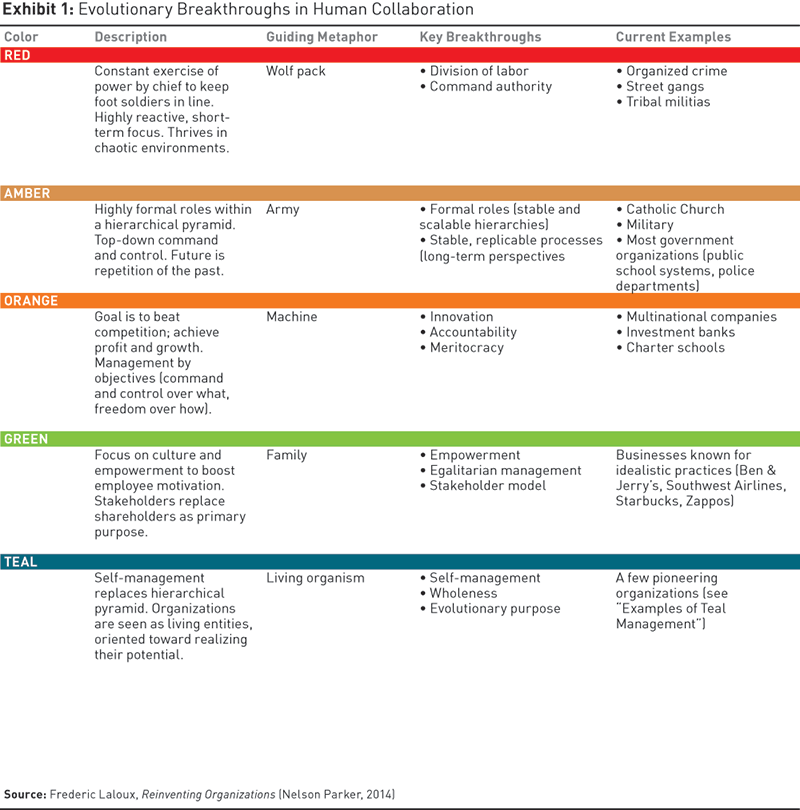
In describing the pattern of organizational evolution, I draw on the work of a number of thinkers in a field known as “developmental theory.” One of its basic concepts is the idea that human societies, like individuals, don’t grow in linear fashion, but in stages of increasing maturity, consciousness, and complexity. Various scholars have assigned different names to these stages; philosopher Ken Wilber uses colors to identify them, in a sequence that evokes the light spectrum, from infrared to ultraviolet. I borrow his color scheme as a convenient way to name the successive stages of management evolution (see Exhibit 1).
Around 10,000 years ago, humanity started organizing itself in chiefdoms and proto-empires. With this shift away from small tribes, the meaningful division of labor came into being — a breakthrough invention for its time. With it came the first real organizations, in the form of small conquering armies. These organizations, which in integral theory are labeled Red, are crude, often violent groups. People at this stage of development tend to regard the world as a tough place where only the powerful (or those they protect) get their needs met. This was the origin of command authority. The chief, like the alpha male in a wolf pack, needs to constantly inspire fear to keep underlings in line, and often relies on family members in hopes that they can be trusted. Today’s street gangs, terrorist groups, and crime syndicates are often organized along these lines.
Starting around 4000 BC in Mesopotamia, humanity entered the Amber age of agriculture, state bureaucracies, and organized religion. Psychologically, this leap was enormous: People learned to exercise self-discipline and self-control, internalizing the strong group norms of all agricultural societies. Do what’s right and you will be rewarded, in this life or the next. Do or say the wrong things, and you will be excommunicated from the group.
All agrarian societies are divided into clearly delineated castes. They thrive on order, control, and hierarchy. In organizations, the same principles characterize the Amber stage. The fluid, scheming wolf pack–like Red organizations give way to static, stratified pyramids. The Catholic Church is an archetypal Amber organization, complete with a static organization chart linking all levels of activity in lines and boxes, from the pope at the top to the cardinals below and down to the archbishops, bishops, and priests. Historically, the invention of formal roles and hierarchies was a major breakthrough. It allowed organizations to scale beyond anything Red society could have contemplated. Amber organizations produced the pyramids, irrigation systems, cathedrals, the Great Wall of China, and other structures and feats that were previously unthinkable. They also considerably reduced violence; a priest whose role is defined by a box in an organization chart doesn’t scheme to backstab a bishop who shows a sign of weakness. A second breakthrough was the invention of stable, replicable processes, such as the yearly cycle of planting, growing, and harvest in agriculture.
Today, this hierarchical and process-driven model is visible in large bureaucratic enterprises, many government agencies, and most education and military organizations. In Amber organizations, thinking and execution are strictly separated. People at the bottom must be instructed through command and control. In today’s fast-changing, knowledge-based economy, this static, top-down conception of management has proven to be inefficient; it wastes the talent, creativity, and energy of most people in these organizations.
Starting with the Renaissance, and gaining steam with the Enlightenment and the early Industrial Revolution, a new management concept emerged that challenged its agrarian predecessor. In the Orange paradigm, the world is no longer governed by absolute, God-given rules; it is a complex mechanism that can be understood and exploited through scientific and empirical investigation. Effectiveness replaces morality as the yardstick for decision making: The best decision is the one that begets the highest reward. The goal in an Orange organization is to get ahead, to succeed in socially acceptable ways, and to best play the cards one is dealt. This is arguably the predominant perspective of most leaders in business and politics today.
The leap to Orange coincided with three significant management breakthroughs that gave us the modern corporation. First was the concept of innovation, which brought with it new departments such as R&D, product management, and marketing, as well as project teams and cross-functional initiatives. Second wasaccountability, which provided leaders with an alternative to commanding people: Give people targets to reach, using freedom and rewards to motivate them. This breakthrough, sometimes called management by objectives, led to the creation of modern HR practices, budgets, KPIs, yearly evaluations, bonus systems, and stock options. Third wasmeritocracy, the idea that anyone could rise to any position based on his or her qualifications and skills — a radical concept when it appeared.
The transition to Orange brought a new prevailing metaphor. A good organization is not a wolf pack or army, but a machine. Corporate leaders adopted engineering terms to describe their work: they designed the company, using inputs and outputs, information flows, and bottlenecks; they downsized the staff and reengineered their companies. Most large, mainstream publicly listed companies operate with Orange management practices.
In just two and a half centuries, these breakthroughs have generated unprecedented levels of prosperity, added decades to human life expectancy, and dramatically reduced famine and plague in the industrialized world. But as the Orange paradigm grew dominant, it also encouraged short-term thinking, corporate greed, overconsumption, and the reckless exploitation of the planet’s resources and ecosystems. Increasingly, whether we are powerful leaders or low-ranking employees, we feel that this paradigm isn’t sustainable. The heartless and soulless rat race of Orange organizations has us yearning for more.
Postmodernity brought us another world view. The Green stage stresses cooperation over competition and strives for equality, solidarity, and tolerance. Historically, this perspective inspired the fights for the abolition of slavery, and for gender equality, and today it helps combat racism, homophobia, and other forms of discrimination. Green organizations, which include many nonprofits as well as companies such as Southwest Airlines, Starbucks, and the Container Store, consider social responsibility the core of their mission. They serve not just shareholders but all stakeholders, knowing that this often results in higher costs in the short term, but better returns in the end.
Green leaders have championed the soft aspects of business — investing in organizational culture and values, coaching, mentoring, and teamwork — over the hard aspects of strategy and budgeting so prized in Orange. Family is their metaphor; everyone’s voice should be heard and respected. You can’t treat knowledge workers like cogs in a machine. Empowerment and egalitarian management are among the breakthroughs they introduced.
Practice shows, alas, that empowerment and egalitarian management are hard to sustain. Efforts to make everyone equal often lead to hidden power struggles, dominant actors who coopt the system, and organizational gridlock. Green companies, universities, and organizations that take egalitarianism too far have tended to bog down in debate and factionalism. Successful Green companies maintain a careful balance: taming the traditional hierarchy through constant investment in training and culture; reminding leaders and managers to wield their power carefully; and raising the skills of people on the front lines.
All of these organizational paradigms coexist today. In any major city one can find Red organizations (entities at the fringes of the law), Amber organizations (public schools and other government entities), Orange organizations (Wall Street and Main Street companies), and Green organizations (values-driven businesses and many nonprofits). Look closely at how an organization operates — its structure, leadership style, or any core management process — and you can quickly guess the dominant paradigm. Take compensation, for example: How are people rewarded? In a Red company, the boss shares the spoils as he or she pleases, buying allegiance through reward and punishment. In Amber organizations, salaries are tightly linked to a person’s level in the hierarchy (“same rank, same pay”) and there are no incentives or bonuses. Orange companies offer individual incentives to reward star performers, while Green companies generally award team bonuses to encourage cooperation.
Today, in small but increasing numbers, leaders are growing into the next stage of consciousness, beyond Green. They are mindful, taming the needs and impulses of their ego. They are suspicious of their own desires — to control their environment, to be successful, to look good, or even to accomplish good works. Rejecting fear, they listen to the wisdom of other, deeper parts of themselves. They develop an ethic of mutual trust and assumed abundance. They ground their decision making in an inner measure of integrity. They are ready for the next organizational paradigm. Its color is Teal.
The Nature of Teal
In 2012, I set out to find some examples of Teal organizations and describe the factors that set them apart. To qualify, an organization had to employ a minimum of 100 people and had to have been operating for a minimum of five years in ways that were consistent with the characteristics of a Teal stage of human development.
After screening a great number of organizations, I focused on 12, selecting those that were most advanced in reinventing management structures and practices. (See “Examples of Teal Management,” where ten are listed; the other two, AES and BSO/Origin, reverted back to more traditional management practices after a change of CEO or ownership). I was struck by the diversity of these organizations. They include publicly held and privately held for-profit corporations along with nonprofits in the consumer products, industrial, healthcare, retail, and education industries. Typically, the leaders of these companies didn’t know about one another. They often thought they were the only ones to be so foolhardy as to rethink their management practices in fundamental ways. Yet, after much trial and error, they came up with strikingly similar approaches to management. It seems that a coherent new organizational model is emerging.
Examples of Teal Management
Buurtzorg: a Netherlands-based healthcare nonprofit, profiled in this article.
ESBZ: a publicly financed school in Berlin, covering grades seven to 12, which has attracted international attention for its innovative curriculum and organizational model.
FAVI: a brass foundry in France, which produces (among other things) gearbox forks for the automotive industry, and has about 500 employees.
Heiligenfeld: a 600-employee mental health hospital system, based in central Germany, which applies a holistic approach to patient care.
Morning Star: a U.S.-based tomato processing company with 400 to 2,400 employees (depending on the season) and a 30 to 40 percent share of the North American market. (If you have eaten pizza or spaghetti sauce in the U.S., you have probably tasted a Morning Star product).
Patagonia: a US$540 million manufacturer of climbing gear and outdoor apparel; based in California and employing 1,300 people, it is dedicated to being a positive influence on the natural environment.
Resources for Human Development (RHD): a 4,000-employee nonprofit social services agency operating in 14 states in the U.S., providing services related to addiction recovery, homelessness, and mental disabilities.
Sounds True: a publisher of multimedia offerings related to spirituality and personal development, with 90 employees in the United States.
Sun Hydraulics: a maker of hydraulic cartridge valves and manifolds, with factories in the U.S., the U.K., Germany, and Korea employing about 900 people.
Holacracy: a management system first developed at the Philadelphia-based software company Ternary, which has been adopted by a few hundred profit- and not-for-profit organizations around the world, most famously by Zappos.
Like previous leaps to new stages of management, the new model comes with a number of important breakthroughs:
• Self-management. Teal organizations operate effectively, even at a large scale, with a system based on peer relationships. They set up structures and practices in which people have high autonomy in their domain, and are accountable for coordinating with others. Power and control are deeply embedded throughout the organizations, no longer tied to the specific positions of a few top leaders.
• Wholeness. Whereas Orange and Green organizations encourage people to show only their narrow “professional” selves, Teal organizations invite people to reclaim their inner wholeness. They create an environment wherein people feel free to fully express themselves, bringing unprecedented levels of energy, passion, and creativity to work.
• Evolutionary purpose. Teal organizations base their strategies on what they sense the world is asking from them. Agile practices that sense and respond replace the machinery of plans, budgets, targets, and incentives. Paradoxically, by focusing less on the bottom line and shareholder value, they generate financial results that outpace those of competitors.
Changing Paradigms at Buurtzorg
Buurtzorg, a large Dutch nursing care provider, is a good example of an organization running with Teal management structures and practices. Since the 19th century, every neighborhood in the Netherlands has had a local nurse who makes home visits to care for the sick and the elderly. These nurses operated largely autonomously until the early 1990s. Then, to maximize efficiency and reduce costs, the government created incentives for care-giving agencies to merge into larger enterprises.
The new agencies, most of which were private companies, gravitated toward an Orange paradigm. Seeking to minimize downtime and allocate staff flexibly, they set up centralized call centers; instead of calling their nurse personally, clients now had to dial the center. Planners were hired to devise daily visiting schedules that minimized travel times. The agencies instituted time standards: 10 minutes for intravenous injections, 15 minutes for bathing, and 2.5 minutes for changing a compression stocking. Barcode stickers, placed on patients’ front doors, tracked the nurses’ progress so central managers could analyze their efficiency. As these organizations consolidated, they added more layers of management, all with the intention of increasing efficiencies and squeezing out costs.
The outcome has been distressing to patients and nurses alike. Clients, who are often elderly, have to cope with new faces in their home at every visit. They must repeat their medical histories to hurried nurses who have no time allotted for listening. The nurses, for their part, find these working conditions degrading. They know they should spend more time trying to understand the changing conditions of their patients, but they simply can’t. The whole system is prone to errors, conflicts, and complaints
Buurtzorg (the name means neighborhood care in Dutch) was founded in 2006 by Jos de Blok, who had experienced these problems firsthand, as a nurse for 10 years and then as a manager. His new organization is extraordinarily successful, having grown from four to 9,000 nurses in its first eight years and achieving outstanding levels of care. He set up the company as a self-managing enterprise. Nurses work in teams of 10 to 12, each team serving around 50 patients in a small, well-defined neighborhood.
Buurtzorg has a distinctive outlook on the nature of care. Its purpose is not to give shots and change bandages as efficiently as they can, but to help its patients live, as much as possible, a rich and autonomous life. Nurses regularly sit down for coffee with their patients. They help them structure their own support networks and reach out to families and neighbors. Patients see the same one or two nurses all the time, and often form deep bonds of trust and intimacy with them.
Clients and nurses love Buurtzorg. Only eight years after its founding, its market share has reached 60 percent. Financially, the results are stellar, too. One 2009 study found that Buurtzorg requires, on average, only 40 percent of the care hours needed by a more conventional approach, because patients become self-sufficient much faster. Emergency hospital admissions have been cut by a third, and the average hospital stay of a Buurtzorg patient is shorter. It’s estimated that the Dutch social security system would save $2 billion per year if the entire home-care industry adopted Buurtzorg’s operations model.
Self-Management and Its Misconceptions
Buurtzorg’s 9,000 employees operate entirely with self-managing practices. Local teams of 10 to 12 nurses decide which patients to serve, how to allocate tasks, where to rent offices, how to integrate with the local communities, which doctors and pharmacies to work with, and how to collaborate with nearby hospitals. They monitor their own performance and take corrective action if productivity drops. Teams don’t have team leaders; management tasks are spread across the members, all of whom are nurses.
One common misconception about self-management is that everyone is equal and decisions are made by consensus, which requires endless meetings. The truth is very different. Self-management requires a whole set of interlocking structures and practices, so that decision rights and power flow to any individual who has the expertise, interest, or willingness to step in to oversee a situation. Fluid, natural hierarchies replace the fixed power hierarchies of the pyramid. This requires explicit training. At Buurtzorg, all new team members take a course called Solution-Driven Methods of Interaction, learning sophisticated listening and communication skills, techniques for running meetings and making decisions, and methods of coaching one another and providing perspective.
You might assume that all this is managed through staff functions — the source of capability and power in many Orange and Green organizations. But Buurtzorg’s 9,000 nurses are supported by fewer than 50 staff people. The nurses do their own recruiting and purchasing, contracting for specialized medical or legal expertise when needed. They align with the larger organization not through rules and procedures, but through the collaboration methods they learned. A powerful internal social network allows them to draw on guidance and medical expertise from fellow nurses in other parts of the country, many of whom they’ve never met.
The Embrace of Wholeness
In Amber, Orange, and Green organizations, people typically show up wearing a mask: the bishop’s robe, the doctor’s white coat, and the executive’s suit all embody subtle, but real, expectations. Leaders fear that if people brought all of themselves to work — their moods, quirks, deepest aspirations, and uncertainties — things would quickly fall into disorder. Most people adopt an air of resolution and determination, favoring their masculine, rational selves. It feels unsafe to reveal the caring, inquiring, intuitive, and spiritual aspects of the self, or to express a desire for meaning. Many of us end up disowning some fundamental aspects of our selves. When an organization feels lifeless, is it because we bring so little life to work?
Teal organizations start from the premise, resonant with many wisdom traditions, that a person’s deepest calling is to achieve wholeness. These organizations engender vibrant workspaces and practices where trust flourishes. People feel they can truly be themselves. Simple management practices foster a sense of personal connection. At Patagonia’s headquarters in Ventura, Calif., for example, the company maintains a child development center for employees’ preschoolers. Children’s laughter and chatter are regularly heard; kids visit their parents’ desks, join adults for lunch at the cafeteria, and run around in the playground outside. One sometimes sees a mother nursing her child during a meeting. At another Teal company, Sounds True, people regularly bring their dogs to work. Meetings often take place with two or three dogs lying at people’s feet. Having children and animals present tends to reconnect people with deeper parts of themselves; they see one another not only as colleagues, but as part of a common humanity.
One harbinger of the rise of consciousness in the business world is the support given to contemplative practices. It’s becoming fashionable, even in Wall Street banks, to offer meditation classes. But these are often treated as add-ons, separate from the real work. At the Heiligenfeld hospital chain inner work is woven deeply into daily life. Every week, colleagues from their five hospitals come together for 75 minutes of intensive, reflective dialogue about a theme such as dealing with risks or learning from mistakes. Heiligenfeld also devotes four days per year to silence. The staff speaks only when needed, in whispers; patients engage in forms of therapy that require no words, such as walks in the woods or painting sessions. People learn to interact from a deep place when words are not at hand.
The quest for wholeness can also be seen on the factory floor. At FAVI, a French automotive supplier, all engineers and administrative workers are trained to operate at least one assembly-line machine. When orders must be rushed out, white-collar workers come in to run the machines for a few hours. It’s a wonderful community-building practice. People in engineering and administrative roles work under the guidance of the machine operators. They see for themselves how hard the work on the machines can be and how much skill it involves.
FAVI also has an in-depth onboarding process that ends with new teammates writing an open letter to the colleagues they have joined. The letters often describe how, perhaps for the first time in their career as a machine operator, their voice counts at work and they are considered worthy of trust and appreciation.
Evolutionary Purpose
Most organizations define a purpose for themselves in the form of a mission statement, which is typically engraved on a plaque in the headquarters lobby. Most of these statements, of course, sound hollow. The espoused purpose can’t compete with the pursuit of profits or competitive advantage.
Buurtzorg’s purpose, as discussed above, is to help sick and elderly patients live a rich and autonomous life. Its competitive advantage is the way it fulfills that purpose, with self-organization and wholeness. If it were a more traditional organization, it would try to keep this competitive advantage secret, and gain market share accordingly. Founder de Blok did the opposite. He wrote a book (Buurtzorg: Menselijkheid Boven Bureaucratie, [Boom Lemma uitgevers, 2010], coauthored with Aart Pool, whose title translates as “Humanity above Bureaucracy”) in which he documented Buurtzorg’s revolutionary ways of operating in great detail. He accepts all invitations from competitors to explain his methods, and acts as an advisor for two direct competitors without compensation.
“The whole notion of competition makes no sense,” says de Blok. “If you share knowledge and information, things will change more quickly.”
Making purpose the cornerstone of an organization has profound consequences for leadership. In today’s dominant management paradigm (Orange), leaders are supposed to define a winning strategy and then marshal the organization to execute it, like the human programmer of a machine who controls what it will do. In the Teal paradigm, founders and leaders view the organization as a living entity, with its own energy, sense of direction, and calling to manifest something in the world. They don’t force a course of action; they try to listen to where the organization is naturally called to go. None of the organizations I researched has a strategy document. Gone are the often dreaded strategy formulation exercises, and much of the machinery of midterm plans, yearly budgets, cascaded KPIs, and individual targets. Instead of trying to predict and control, they aim to sense and respond.
FAVI uses a metaphor to explain this. Other companies look five years ahead and make plans for the next year. They prefer to think like farmers: Look 20 years ahead, and plan only for the next day. A farmer must look far out when deciding which fruit trees to plant or which crops to grow. But it makes no sense to plan a precise date for the harvest. One cannot control the weather, the crops, the soil; they all have a life of their own. Sticking rigidly to plan, instead of sensing and adjusting to reality, leads to having the harvest go to waste, which too often happens in organizations.
Practices based on sensing and responding, combined with self-management, lead to high levels of innovation. Two nurses on a Buurtzorg team found themselves pondering the fact that elderly people, when they fall, often break their hips. Could Buurtzorg help prevent this? Their team created a partnership with a physiotherapist and an occupational therapist from their neighborhood. They advised patients on small changes they could bring to their home interiors, and changes of habit that would minimize the risk of falling. Happy with their success, they approached de Blok to suggest turning “Buurtzorg+” (Buurtzorg + prevention) into a national program.
Had de Blok been a traditional CEO, he might have analyzed the idea and, if he approved it, assigned a team in headquarters to develop a comprehensive implementation plan. His actual answer was much humbler: Why should he, rather than the system itself, decide if this was a wise thing to do? He suggested that the same team of nurses package their approach and disseminate the idea on the company’s internal social network. Hundreds of teams showed interest and the idea quickly caught on. Within a year, almost all teams had incorporated prevention into their work using that model.
In a self-managing, purpose-driven organization, change can come from any person who senses that change is needed. This is how change has occurred in nature for millions of years. Innovation doesn’t happen centrally, according to plan, but at the edges, when some organism senses a change in the environment and experiments to find an appropriate response. Some attempts fail to catch on; others rapidly spread to all corners of the ecosystem.
Becoming a Teal Organization
Some companies, like Buurtzorg, are advanced on all three Teal breakthroughs: self-management, wholeness, and evolutionary purpose. Others are more advanced in one area than others — FAVI in self-management, Heiligenfeld in wholeness. None of the Teal companies I have identified have the scale of the largest Orange companies (such as Walmart) or Green ones (such as Southwest Airlines). This is still the dawn of the Teal paradigm. However, its promise is suggested by the success these organizations are having.
Every stage of organizational evolution is more mature and effective than the previous stage, because of the inherent attitude toward power. A Red leader asks, How can I use my power to dominate? An Amber leader asks, How can I use it to enforce the status quo? An Orange leader asks, How can we win? A Green leader asks, How can we empower more people? A Teal leader asks, How can everyone most powerfully pursue a purpose that transcends us all?
Research suggests that there are two — and only two — necessary conditions for developing a Teal organization.
1. Top leadership. The chief executive must have an integrated world view and psychological development consistent with the Teal paradigm. It is helpful if a few close colleagues share this perspective.
2. Ownership. Owners of the organization must also understand and embrace Teal world views. Board members who don’t get it, experience shows, can temporarily give a Teal leader free rein. But when the organization hits a rough patch or faces a critical choice, owners will want to regain control in the only way that makes sense to them: appointing a CEO who exerts top-down, hierarchical authority.
What about businesses, nonprofits, schools, hospitals, government agencies, and other institutions where these conditions are not in place? Can a middle manager hope to influence an entire enterprise by showcasing Teal practices locally? As much as I would like to believe this is possible, my hopes are not high. Experience shows that it takes more than a successful local example to catalyze this sort of system-wide change.
However, as a middle or senior manager, you can introduce some elements of the new paradigm for your own benefit and that of your colleagues. Practices that encourage people to show more of their true selves might come across as unusual, but are unlikely to raise red flags with top leadership. Some elements of self-management can be introduced; for example, instead of imposing new targets, ask team members to determine, in a peer-based process, which targets could be changed. If the team functions well, don’t attend the meeting. Let them come up with the best solution on their own so the targets will be theirs. Or when it’s time to appoint someone to report to you, don’t do it yourself. Let the team one level below write up the job description, interview candidates, and select their boss. Executives who have tried this find that subordinates take choosing their boss very seriously, and the process gives the boss a much stronger working relationship with the team.
The full benefit, of course, accrues to those organizations that fully embrace the new paradigm. When I spent a day with de Blok in the small headquarters of Buurtzorg, I was struck by how much simpler work life could be. Buurtzorg is a 9,000-person organization growing at breakneck speed. But after several hours of conversation, I realized we hadn’t been interrupted once. No urgent phone calls; no assistant coming in to whisper in the CEO’s ear that something had come up. Work in Teal organizations seems to unfold so easily it sometimes verges on the magical. Control and self-correction is embedded in the system, and no longer requires leaders to be on top of everything at all times.
In the past, with every change in consciousness (from Red to Amber to Orange and to Green), more powerful and life-enhancing forms of management have emerged. After the full emergence of the Teal paradigm, we will probably look back and find the organizational forms and practices of the late 20th and early 21st century alienating and unfulfilling. Already, it’s clear that we can create radically more productive, soulful, and purposeful businesses and nonprofits, schools, and hospitals. We are at an inflection point: a moment in history where it’s time to stop trying to fix the old model and instead make the leap to the next one. It will be better suited to the complexity and challenges of our times, and to the yearning in our hearts.
The story line of evolution in this article, and the use of colors to describe stages, draws on the work of several thinkers, including Clare Graves, Ken Wilber, Jenny Wade, Don Beck, Robert Kegan, and Jane Loevenger.
This great article by Zat Rana appeared on medium, since there were so many positive reactions from friends when I shared it, I felt to share the the entire article here.
Once upon a time, some 13.799 billion years ago, a state which we call the singularity sparked the void. It’s a state in which the laws of physics as we know them don’t work; a state that supposedly birthed the Universe. With it, we got space and time, energy and matter, all dancing and kissing as everything began to expand. Every atom, every star, every galaxy, every planet shot out of that one, lonely point of infinity.
These creations of ordinary matter, which include the speck of dust we call Earth, however, only make up 0.3 percent of the Universe. Around 68 percent of it is occupied by dark energy, an unknown entity responsible for the expansion of space. A further 27 percent is made up of dark matter, another mostly unknown entity. The remaining 5 percent is what we know and study, including that humble 0.3 percent of the total.
Even then, within this tiny fraction, the Milky Way has to contend with some 200 billion galaxies, the Sun with a septillion stars (a one with 24 zeroes), and our miniature home with somewhere in the range of another septillion planets. In the broader cosmological drama, not only is Earth not the main actor, but the idea that it has any meaningful role to play at all is absorbed and then dwarfed by sheer quantification.
And yet, here we are — in this particular moment, occupying two different coordinates of space. Right now, I am somewhere, doing something, and you are somewhere else, reading this. In some past, I have written this for you: a conscious observer, who I do not know, who I will never meet. You have felt things and you have thought things in your life, just as I have felt things and I have thought things in my life. As the present unfolds, your rich, complex history is colliding with my own to generate an entirely new history, one of consequence, one previously non-existent.
With the magic of technology, in spite of our relative smallness, there is a different kind of largeness in the connection making this interaction possible; a juxtaposition highlighted by the great astronomer Carl Sagan when he asked us to briefly pause for a moment to look at the following image.
“Look again at that dot. That’s here. That’s home. That’s us. On it everyone you love, everyone you know, everyone you ever heard of, every human being who ever was, lived out their lives. The aggregate of our joy and suffering, thousands of confident religions, ideologies, and economic doctrines, every hunter and forager, every hero and coward, every creator and destroyer of civilization, every king and peasant, every young couple in love, every mother and father, hopeful child, inventor and explorer, every teacher of morals, every corrupt politician, every “superstar,” every “supreme leader,” every saint and sinner in the history of our species lived there–on a mote of dust suspended in a sunbeam.”
It’s as beautiful and as true of a summation as we can hope for. But as its charm wears off, what do we do about the tension? How do we reconcile these seeming contradictions: that we are large in our collection of experiences but small in the Universe; that on the surface everything matters but in the sky, very little of it does; that the stories we tell ourselves seem true and meaningful in the moment but once we step away from them, they fall apart? What — if anything — is there for us hold onto?
If we zoom onto Earth for a moment, taking a 100,000-foot view, watching what is going, say, as a hypothetical Martian would, one conclusion would be easy to come to: Humans are different from other animals on the planet. We are all a product of evolution, yes. We still have similar instincts, sure. But at the level of consciousness, there is something that distinguishes us — something that allows us to challenge evolution itself.
The physicist David Deutsch argues that it’s because we are what he calls the great explainers. We can create knowledge outside of our physical body — like math, philosophy, literature — and then collectively build on it to learn about reality in a way that allows us to master more and more of the problems that arise in our ecology. That’s, for example, why we have been able to use science to make so much progress in the last 400 years, going from building simple telescopes to landing people on the Moon.
There is, however, an even more fundamental cause: Humans are a more complex, more networked species with more interconnections than the rest of the participants in the animal kingdom. Our unique conscious experience has gifted us with languages that allow us to create culture — a social reality that lives, breathes, evolves unlike anything else in nature. Our individual brains are nodes in an enormous network of brains that synergize to create something larger than their constituents, indeed allowing us to create knowledge as Deutsch suggests, but also so much more.
Modern society has a bias towards the material, the world of matter. If we can’t see it, we find it hard to treat as real. As such, immaterial things emerging from complexity, like culture, are seen as less meaningful than matter. If you can’t touch it, then it must not be real, right? Except, that’s not how it works. Culture may not be tangible, but it influences matter in a way that is. Our brains are programmed by culture, technology is a physical embodiment of culture, violence is reduced by culture.
In the 20th-century, the study of phenomenology began to catch traction with a simple idea: The starting point of our philosophical inquiry should be our direct conscious experience. Before we can describe matter, we have to first contend with the fact that there is something right here — something strange going on if we just stop and look; a world constructed in front of us that simply is, before we can even get to analyzing it. Why has evolution allowed us to see different colors? Why can we think, be aware, when a simple stimulus-response feedback loop might have done the job?
Whatever the answer to these questions is, the point is that the social reality — produced at the intersection of an infinite set of conscious experiences — is just as real as the physical reality. And it’s not just a subjective phenomenon, either, which only applies to what you make up in your own mind. It’s a whole different plane of existence that has emerged — just like stars and galaxies and planets emerged, just like life itself emerged — and it’s continuously evolving and, slowly, dominating the world of matter.
Contained within this life-force, we find everything that makes our speck of dust just a little brighter: kindness and morality, love and community, hope and innovation, curiosity and science, beauty and art. The value of all these things is so obvious that only a blind, mistaken mind would dare to use reason to try to intellectualize their meaning away. From a phenomenological point of view, these things are simply there, and they affect your conscious experience very lucidly, and they don’t care what you think about them.
Humans have had a complex, contradictory history. On one end, given our impact on the ecology and on other sentient beings, it’s hard to overlook that we are perhaps the most destructive force that has ever walked this planet. We kill, we conquer, and then we kill again. And yet, there is more: In spite of the missteps, humans are also the only known creatures in the Universe that have been able to use culture to show the potential for a reality without violence. At least within our own sphere of existence, progress has leaned towards a gentler, more loving way of being.
Homo Sapiens have roamed the planet for about 200,000 years. A typical mammalian species lives for around 2 million years. Still, somehow, in that short period, we have been able to wipe out diseases, split the atom, and escape Earth’s atmosphere. Best of all? If the rate of cultural change continues at the present pace, then there is more and more to come in shorter and shorter time-frames, as long as we endure. We are still a young species. If we open up our imagination even just a little bit, it’s not hard to see how the possibilities are potentially endless.
We may not yet be anything more than a fraction of a ripple in the infinite sea of space-time, but all evidence points to the fact that perhaps we could be. We may not be special based on our spatial position in the cosmos, but the emergence of our social reality and the potential it offers means that everything that we do matters, in both big and small ways.
Our collective cultural consciousness is a great web tangled into the very fabric of reality. Each of us is connected to it. Each of our actions shape some part of it. Each of our thoughts produce a current that alters its aim. Once it came into being those thousands of years ago, there was nothing that we could do to stop it from evolving. And evolve it will, whether we like it or not, whether we choose to consciously participate in its formation or not.
The purpose of life is right in front of us: It’s to create a reality we want to inhabit — to reach towards the better end of our conscious experience. At each moment, in every second of life, we are given a choice about how we want to conduct ourselves in this world, and though it might not always seem like it, each of these choices are of consequence. They each interact with culture to give it a new form; a form that we are responsible for creating by either doing what is right or doing what is wrong in that specific moment.
A grandfather telling stories to a young boy may just nudge that boy to one day write his own stories, ones that help ease the burden on all our minds. An especially caring teacher may infect a little girl with an engineering passion that later gives her the vitality to make the breakthrough that permanently changes our relationship to outer space. And of course, both that boy and that girl may just inspire millions of other people, who may inspire many millions more, in a long, unbroken chain of interactions until perhaps, one day, the ideas of war and hate and poverty will be foreign to us — or at least take a different form, one that is, again, a little kinder, a little gentler.
After 13.799 billion years of darkness, light finally emerged. This light may be so infinitely small as to not be of consequence, and we may not be the only carriers of it in the Universe, and it may not even mean what we think it means — all of these could be true. But ultimately, we don’t know. All we know is that it’s here, and the only way to find out is by spreading its brightness.
These principles and his approach are another language of "systems thinking" applied to economics and business - which we in Green Economy Think Tank community in the framing of "biomimicry for finance."
Kelly wrote:
"First there is hard rock planet; then there is life, lots of it. First barren hills; then brooks with fish and cattails and red-winged blackbirds. First an acorn; then an oak tree forest.
I'd like to be able to do that. First a hunk of metal; then a robot. First some wires; then a mind. First some old genes; then a dinosaur.
"How do you make something from nothing? Although nature knows this trick, we haven't learned much just by watching her. We have learned more by our failures in creating complexity and by combining these lessons with small successes in imitating and understanding natural systems. So from the frontiers of computer science, and the edges of biological research, and the odd corners of interdisciplinary experimentation, I have compiled The Nine Laws of God governing the incubation of somethings from nothing:
Distribute being
Control from the bottom up
Cultivate increasing returns
Grow by chunking
Maximize the fringes
Honor your errors
Pursue no optima; have multiple goals
Seek persistent disequilibrium
Change changes itself.
"These nine laws are the organizing principles that can be found operating in systems as diverse as biological evolution and SimCity. Of course I am not suggesting that they are the only laws needed to make something from nothing; but out of the many observations accumulating in the science of complexity, these principles are the broadest, crispest, and most representative generalities. I believe that one can go pretty far as a god while sticking to these nine rules."
"Distribute being. The spirit of a beehive, the behavior of an economy, the thinking of a supercomputer, and the life in me are distributed over a multitude of smaller units (which themselves may be distributed). When the sum of the parts can add up to more than the parts, then that extra being (that something from nothing) is distributed among the parts. Whenever we find something from nothing, we find it arising from a field of many interacting smaller pieces. All the mysteries we find most interesting -- life, intelligence, evolution -- are found in the soil of large distributed systems."
"Control from the bottom up. When everything is connected to everything in a distributed network, everything happens at once. When everything happens at once, wide and fast moving problems simply route around any central authority. Therefore overall governance must arise from the most humble interdependent acts done locally in parallel, and not from a central command. A mob can steer itself, and in the territory of rapid, massive, and heterogeneous change, only a mob can steer. To get something from nothing, control must rest at the bottom within simplicity."
"Cultivate increasing returns. Each time you use an idea, a language, or a skill you strengthen it, reinforce it, and make it more likely to be used again. That's known as positive feedback or snowballing. Success breeds success. In the Gospels, this principle of social dynamics is known as "To those who have, more will be given." Anything which alters its environment to increase production of itself is playing the game of increasing returns. And all large, sustaining systems play the game. The law operates in economics, biology, computer science, and human psychology. Life on Earth alters Earth to beget more life. Confidence builds confidence. Order generates more order. Them that has, gets."
"Grow by chunking. The only way to make a complex system that works is to begin with a simple system that works. Attempts to instantly install highly complex organization -- such as intelligence or a market economy -- without growing it, inevitably lead to failure. To assemble a prairie takes time -- even if you have all the pieces. Time is needed to let each part test itself against all the others. Complexity is created, then, by assembling it incrementally from simple modules that can operate independently."
"Maximize the fringes. In heterogeneity is creation of the world. A uniform entity must adapt to the world by occasional earth-shattering revolutions, one of which is sure to kill it. A diverse heterogeneous entity, on the other hand, can adapt to the world in a thousand daily minirevolutions, staying in a state of permanent, but never fatal, churning. Diversity favors remote borders, the outskirts, hidden corners, moments of chaos, and isolated clusters. In economic, ecological, evolutionary, and institutional models, a healthy fringe speeds adaptation, increases resilience, and is almost always the source of innovations."
"Honor your errors. A trick will only work for a while, until everyone else is doing it. To advance from the ordinary requires a new game, or a new territory. But the process of going outside the conventional method, game, or territory is indistinguishable from error. Even the most brilliant act of human genius, in the final analysis, is an act of trial and error. "To be an Error and to be Cast out is a part of God's Design," wrote the visionary poet William Blake. Error, whether random or deliberate, must become an integral part of any process of creation. Evolution can be thought of as systematic error management."
"Pursue no optima; have multiple goals. Simple machines can be efficient, but complex adaptive machinery cannot be. A complicated structure has many masters and none of them can be served exclusively. Rather than strive for optimization of any function, a large system can only survive by "satisficing" (making "good enough") a multitude of functions. For instance, an adaptive system must trade off between exploiting a known path of success (optimizing a current strategy), or diverting resources to exploring new paths (thereby wasting energy trying less efficient methods). So vast are the mingled drives in any complex entity that it is impossible to unravel the actual causes of its survival. Survival is a many-pointed goal. Most living organisms are so many-pointed they are blunt variations that happen to work, rather than precise renditions of proteins, genes, and organs. In creating something from nothing, forget elegance; if it works, it's beautiful."
"Seek persistent disequilibrium. Neither constancy nor relentless change will support a creation. A good creation, like good jazz, must balance the stable formula with frequent out-of-kilter notes. Equilibrium is death. Yet unless a system stabilizes to an equilibrium point, it is no better than an explosion and just as soon dead. A Nothing, then, is both equilibrium and disequilibrium. A Something is persistent disequilibrium -- a continuous state of surfing forever on the edge between never stopping but never falling. Homing in on that liquid threshold is the still mysterious holy grail of creation and the quest of all amateur gods."
"Change changes itself. Change can be structured. This is what large complex systems do: they coordinate change. When extremely large systems are built up out of complicated systems, then each system begins to influence and ultimately change the organizations of other systems. That is, if the rules of the game are composed from the bottom up, then it is likely that interacting forces at the bottom level will alter the rules of the game as it progresses. Over time, the rules for change get changed themselves. Evolution -- as used in everyday speech -- is about how an entity is changed over time. Deeper evolution -- as it might be formally defined -- is about how the rules for changing entities over time change over time. To get the most out of nothing, you need to have self-changing rules."


 If you don't know what TEAL is referring to - this is a great article to read by the author of "Reinventing Organizations"