BALLE, The Business Alliance for Local Living Economies is a national effort of independent business networks in over 80 cities.
Green Business Networking, the non-profit business community I started in 2006, is the LA County BALLE network dedicated to serving LA Region's business professionals and owners building our green economy!
Here's an inspiring video about the BALLE effort, and conference - and look for my brief comment at 3:21 into the video:
Place Matters: Living Economies 2011 from BALLE on Vimeo.
Sunday, April 17, 2011


Thursday, March 24, 2011
Measuring our success and standard of living - it's not only about the money we make!
There was a sign in Albert Einstein's office at Princeton which said: "Not everything that counts can be counted, and not everything that can be counted counts."
With our singular focus on money in our global culture, many carry the belief that simply "more money" equals "more happy". At a very basic level of subsistence more material goods and services in our lives are necessary for a degree of happiness, but beyond the fundamental level, there are diminishing happiness returns on every extra dollar of income or accumulation. All of us know in our heart of hearts that at for anyone who has their basic needs met, the "more money equals more happy" is not really true.
Then, how do we measure the standard of living or true well being happiness in a community or a region? Challenge is that our much of lives and well being do not all fall into the category of "economic activity." Yet the issue remains -- how do you MEASURE the level of progress and standard of living in all of the non-financial dimensions?
In his book "Prosperity without Growth - Economics for a Finite Planet" Tim Jackson states:
"There is an interesting overlap between components of prosperity and the factors that are known to influence subjective well being or 'happiness'. Indeed to the extent that we are happy when things go well, and unhappy when they don't, there is an obvious connection between prosperity and happiness. This doesn't necessarily meant that prosperity is the same thing as happiness. But the connection between the two provides a useful link into recent policy debates about happiness and subjective well being."
Some of the components of "quality of life" - real wealth - are loving relationships, supportive and vibrant community, good health, cultural and creative stimulation, healthy and vibrant natural environment, contributing to society in a meaningful way and spiritual fulfillment.
Yet, ironically, one of the key methods that most countries define standard of living is the measure of "Gross National Product" or GDP, which is simply a financial measure of economic activity. But to meet the Earth’s challenges, these outmoded ways of measuring the “product” of our economy have to be reexamined. They are out of touch with our finite supply of natural resources (or natural capital) upon which our economic growth depends and they are similarly out of touch with the non-financial dimensions of the well being of participants in a society.
Saturday, February 26, 2011
Article - "What’s blocking sustainability? Human nature, cognition, and denial"
We are in the midst of a paradigm shift from the old ways of understanding reality to a more sustainable civilization. William Rees wrote an article that articulates key concepts.
In summary he writes:
In summary he writes:
"In 1992, 1,700 of the world’s top scientists issued a public statement titled The World Scientists’ Warning to Humanity. They reported that “a great change in our stewardship of the Earth and the life on it is required if vast human misery is to be avoided and our global home on this planet is not to be irretrievably mutilated.” More than a decade later, the authors of the Millennium Ecosystem Assessment were moved to echo the scientists’ warning asserting that “[h]uman activity is putting such a strain on the natural functions of the Earth that the ability of the planet’s ecosystems to sustain future generations can no longer be taken for granted.” Ours is allegedly a science-based culture. For decades, our best science has suggested that staying on our present growth-based path to global development implies catastrophe for billions of people and undermines the possibility of maintaining a complex global civilization. Yet there is scant evidence that national governments, the United Nations, or other official international organizations have begun seriously to contemplate the implications for humanity of the scientists’ warnings, let alone articulate the kind of policy responses the science evokes. The modern world remains mired in a swamp of cognitive dissonance and collective denial seemingly dedicated to maintaining the status quo. We appear, in philosopher Martin Heidegger’s words, to be “in flight from thinking.” Just what is going on here? I attempt to answer this question by exploring the distal, biosocial causes of human economic behavior. My working hypothesis is that modern H. sapiens is unsustainable by nature—unsustainability is an inevitable emergent property of the systemic interaction between contemporary technoindustrial society and the ecosphere. I trace this conundrum to humanity’s once-adaptive, subconscious, genetic predisposition to expand (shared with all other species), a tendency reinforced by the socially constructed economic narrative of continuous material growth. Unfortunately, these qualities have become maladaptive. The current coevolutionary pathway of the human enterprise and the ecosphere therefore puts civilization at risk—both defective genes and malicious “memes” can be “selected out” by a changing physical environment. To achieve sustainability, the world community must write a new cultural narrative that is explicitly designed for living on a finite planet, a narrative that overrides humanity’s outdated innate expansionist tendencies. "
Monday, February 07, 2011
Friday, January 28, 2011
Institute for New Economic Thinking - Rethinking Economics
"Overview
Founded in October 2009 with a $50 million pledge byGeorge Soros, the New York City-based Institute for New Economic Thinking is a nonprofit organization providing fresh insight and thinking to promote changes in economic theory and practice through conferences, grants and education initiatives.
The Institute recognizes problems and inadequacies within our current economic system and the modes of thought used to comprehend recent and past catastrophic developments in the world economy. The Institute embraces the professional responsibility to think beyond these inadequate methods and models and will support the emergence of new paradigms in the understanding of economic processes.
The Institute firmly believes in empowering the next generation, providing the proper guidance as we challenge outdated approaches with innovative and ethical economic strategy.
The Institute’s objective is to expand the conversation to create an open discussion for a wider range of people. Some would say that present day dialogue is closed and polarizing. We recognize the need for an environment that is nourished and supported by discourse, a discussion that spans a much wider spectrum of thinking and incorporates the insights of other intellectual disciplines in both the natural and social sciences.
The Institute was conceived during the first half of 2009 through a series of discussions that culminated at a summit in July of 2009 in Bedford, NY."
The co-founder of the institute Research in Motion’s CEO Jim Balsillie gave a particularly good talk as his participation in the panel at the World Economic Forum on the subject of "redefining economics," and rethinking the entire paradigm of the situation.
Monday, January 17, 2011
"Property is intended to serve life" - notes on the fact that corporations are not people.
"Property is intended to serve life, and no matter how much we surround it with rights and respect, it has no personal being. It is part of the earth man walks on. It is not man."
Martin Luther King, Jr.
As a financial advisor, I advise people on their property - and much of that property exists in shares of corporations.
What is a corporation, more than simple property that are collectively owned and operated by human beings?
Oddly enough, however, somewhere in our legal code over the last 150 years such property was given the same rights and voice in our democracy as human beings. Most recently the supreme court has granted business interests unlimited spending in campaigns - thus granting corporations the rights of human beings in the democratic process of governing our society. There is an excellent article on the entire issue called "Wal-Mart is Not a Person" which gives a comprehensive overview of the topic, which excerpts Justice John Stevens of the supreme court:
Stevens addresses this here:
Not all businesses are corrupt, yet when it comes to the simple process of human beings coming together to design ways to serve life, the people that founded this country intended that actual people engaged in democracy. Thus it is imperative that we only grant constitutional rights to actual human beings, not property.
There are a number of movements afoot to amend the constitution, among them is http://movetoamend.org/ which states:
Martin Luther King, Jr.
As a financial advisor, I advise people on their property - and much of that property exists in shares of corporations.
What is a corporation, more than simple property that are collectively owned and operated by human beings?
Oddly enough, however, somewhere in our legal code over the last 150 years such property was given the same rights and voice in our democracy as human beings. Most recently the supreme court has granted business interests unlimited spending in campaigns - thus granting corporations the rights of human beings in the democratic process of governing our society. There is an excellent article on the entire issue called "Wal-Mart is Not a Person" which gives a comprehensive overview of the topic, which excerpts Justice John Stevens of the supreme court:
"It might be added that corporations have no consciences, no beliefs, no feelings, no thoughts, no desires. Corporations help structure and facilitate the activities of human beings, to be sure, and their “personhood” often serves as a useful legal fiction. But they are not themselves members of “We the People” by whom and for whom our Constitution was established."And most interestingly - if we really look at the point of view that holds that corporations are actually persons - then the question which human beings are actually represented by such corporations?
Stevens addresses this here:
"It is an interesting question “who” is even speaking when a business corporation places an advertisement that endorses or attacks a particular candidate. Presumably it is not the customers or employees, who typically have no say in such matters. It cannot realistically be said to be the shareholders, who tend to be far removed from the day-to-day decisions of the firm and whose political preferences may be opaque to management. Perhaps the officers or directors of the corporation have the best claim to be the ones speaking, except their fiduciary duties generally prohibit them from using corporate funds for personal ends. Some individuals associated with the corporation must make the decision to place the ad, but the idea that these individuals are thereby fostering their self-expression or cultivating their critical faculties is fanciful."
Not all businesses are corrupt, yet when it comes to the simple process of human beings coming together to design ways to serve life, the people that founded this country intended that actual people engaged in democracy. Thus it is imperative that we only grant constitutional rights to actual human beings, not property.
There are a number of movements afoot to amend the constitution, among them is http://movetoamend.org/ which states:
"We, the People of the United States of America, reject the U.S. Supreme Court's ruling in Citizens United, and move to amend our Constitution to:
* Firmly establish that money is not speech, and that human beings, not corporations, are persons entitled to constitutional rights.
* Guarantee the right to vote and to participate, and to have our vote and participation count.
* Protect local communities, their economies, and democracies against illegitimate "preemption" actions by global, national, and state governments.
The Supreme Court is misguided in principle, and wrong on the law. In a democracy, the people rule."The simple thought here to take away is that as citizens in this world to we must continuously refine our discernment of the true motive, and the consequences, of decisions, laws, candidates, proposals, and political movements. And to discern whether such laws actually serve the quality of life of human beings.
Friday, January 14, 2011
Article I wrote "Social Capital Markets Conference 2010: The Evolution of Money and Meaning" for Green Money Journal
"Social Capital Markets Conference 2010: The Evolution of Money and Meaning"
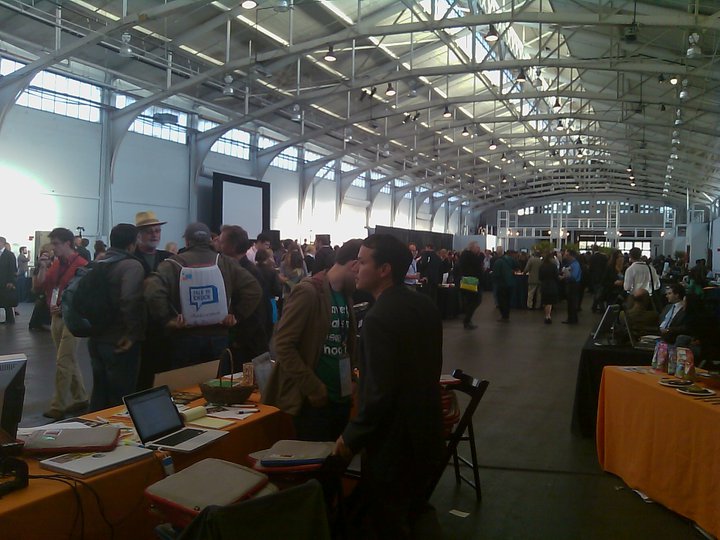
The very existence of the Social Capital Markets conference, known as SOCAP, says it all - over 1,300 vibrant, excited, inspired, brilliant leaders - philanthropists, social entrepreneurs, venture capitalists, micro-finance entrepreneurs, advisors, and consultants who joined together at San Francisco's Fort Mason in early October. They're all working with investing as a means to create better lives for the world's poor, restore and grow healthy ecosystems, foster social entrepreneurs, local food systems, local businesses, and more. All this was just a glimmer in the eye of SRI investors decades ago. Now, it is a reality.
It began this year for me the moment I took a photo of one of the receptions with my phone and posted it with this caption: "Tune in - turn on! Can you feel the Evolution happening? Social Capital Thought Leaders Meta Networking for the Common Good! It's REALLY happening all around the world and a thriving vortex in San Francisco! http://www.socialcapitalmarkets.net "
Estimates are that upwards of $120 billion of investment capital is now available for investments which have meaningful returns, while at the same time address environmental and social woes.
How have things grown, how have things evolved?
There are many areas of development. The meaning of "Capital Market" itself is being explored with innovations like Hoop Fund, where purchass of organic apparel, organic chocolate, quinoa and other foodstuffs are resulting in direct investments in the rural entrepreneurs who produce those products, and the well known micro-finance organization Kiva.org, enabling a global marketplace of people to people investing for good.
The Development of the Impact Investing Space
Impact Investing is a type of Socially Responsible Investing (SRI) that aims to provide environmental or social benefits in addition to economic profit. While the exact size of the Impact Investing market is not known, it is thought to be around $50 billion today, and according to some estimates may reach an astounding $500 billion within the next decade.
Many organizations, including the Rockefeller Foundation, have been part of an effort to create "the basic systems and networks necessary to identify, vet, and monitor investments efficiently"[1]. A comprehensive, dynamic database of the Impact Investing space will be a useful tool for investment advisors in that space who currently rely on a large amount of "one-to-one communication methods" to gather information. Further, those companies seeking investors want a formalized and functioning marketplace to attract capital. The effort is not a small one, and it seems that many smaller efforts have begun to work together. A project created through a Rockefeller Foundation Impact Investment Initiative grantee called the Global Impact Investing Network ( http://www.globalimpactinvestingnetwork.org ) aims to develop the Impact Investing space through a number of initiatives.
These initiatives include:
- IRIS - Impact Reporting and Investment Standards. Includes specific data points in setting impact standards. Sarah Gelfand is director of the IRIS project. More information about IRIS at: http://www.iris-standards.org
- GIIRS - Global Impact Investment Rating System. A rating system similar to Morningstar's on how effective an investment creates an impact in a particular area. The system is being built by B-Lab.
- Data Aggregator - "a repository to compile the data points on multitudes of organizations for market comparisons, benchmarking, and other analytics."
- PULSE - "a web-based portfolio management software application designed to help money managers track the socially positive impact of investments by plugging directly into the IRIS taxonomy and database." Currently 6 companies are using a beta version, and there will be 150 using the next version soon. Acumen is a principle author along with Salesforce, Google, and App-X.
Partners include: Rockefeller Foundation, Deloitte, PricewaterhouseCoopers, Hitachi, Citigroup, Deutsche Bank, J.P.Morgan, the Bill & Melinda Gates Foundation, Imprint Capital, RSF Social Finance, Calvert Foundation, Acumen, and B-Lab.
GIIRS is a ratings endeavor that provides social and environmental impact ratings for companies and funds seeking to raise capital from impact investors.
The GIIRS community has launched the "Pioneer Funds," a compilation of the leading funds in the space, enabling investors, analysts, and researchers to have a better handle on the core of the movement through what are perceived to be the leading funds representing the scope of impact investing. GIIRS is a project of the non-profit B Lab whose mission is to use the power of business for a better world. More information about GIIRS at http://www.giirs.org/about-giirs/about
Twelve leading North American impact investing funds were announced as GIIRS Pioneer Funds at the conference and thirteen leading emerging market funds were highlighted at the Presidential Summit on Entrepreneurship in April. In sum, the 25 GIIRS Pioneer fund managers represent $1.2 billion in assets under management and have investments in more than 200 high impact companies in over 40 countries. The twelve North American Funds named include City Light, Capital, Core Innovation Capital, Equilibrium Capital, Good Capital, Mindful Investors, Murex Investments, Renewal Partners, RSF Social Finance, Satori Capital, SJF Ventures, SustainVC, and TBL Capital. More information at http://www.giirs.org/for-funds/pioneer
Markets with a Mission
Another effort to make the market of impact investments more transparent and thriving was represented by the launch of Mission Markets, "a financial services company that operates ‘The Impact Investment Platform' supporting the social and environmental capital markets." Mission Markets' unique trading platform, Mission Markets Earth Exchange, includes transactions in environmental commodities such as carbon credits and Renewable Energy Certificates (RECs) as well as Wetland Mitigation and Habitat Credits. In the future, lesser known vehicles including Stormwater Runoff Credits, Mangrove Credits, Biomass Units and Marine Carbon Credits. Mission Markets CEO and Founder Michael Van Patten unveiled his groundbreaking platform during the panel entitled "Mapping the Space: Innovative Markets for Good," and stressed that the company supports both social and environmental markets. More on Mission Markets at http://missionmarkets.com
SOCAP has been kind enough to share videos the insightful panel discussions and keynote speakers from its conferences. To view the "Innovative Markets for Good" panel featuring Michael Van Patten and a demonstration of the Mission Market Earth Exchange, visit:http://video.socialcapitalmarkets.net/2010/10/innovative-markets-for-good-mappin...
Getting Individuals and Families Involved
While much of the Impact Investment space has been limited to institutional investors, the Money for Good report by Hope Consulting includes a number of valuable studies to help unlock the Impact Investing marketplace to all sectors. Their initiative outlines that there marketplace represents nearly $120 billion of retail investors willing to invest in impact investing, with amounts smaller than $100,000.
Their studies also outline important barriers due primarily to the fact that impact investing is still in the early stages. Some of the issues are:
- Lack of track record
- Investors don't know where to find information on Impact Investments
- Advisors not recommending Impact Investments
- Limited advice available
- Insufficient ratings/benchmarks
Also their study identified three major segments of investors with different motivations for impact investing: Safety of investment first. Socially focused, and Quality of organization to be invested in.
In order to move forward to broaden the access for individuals, there are several key factors necessary to be developed: Information and infrastructure, Financial Advisors, Products.
For organizations trying to unlock this market:
A. Clarify what impact investing means
B. Build awareness of impact investing and the opportunities available for investors
C. Develop and disseminate information on impact investing to financial advisors
For all organizations involved in Impact Investing:
D. Structure products with small initial investments (<$25,000)
E. Tailor products and messages by segment, to appeal to different motivations
F. Make opportunities accessible to investors
G. Position these as investments, not as alternatives to charity
H. Address barriers related to the markets' immaturity, which are consistent across segments
Another key point is that in order for Impact Investments to reach the retail marketplace, financial advisors need to be a central part of the equation. Here are the points that Hope Consulting identified.
Majority of respondents used an advisor:
- #1 source of information for investors
- 45% want to transact through their advisor
However, many advisors don't know about these opportunities. And when they do know, they see barriers to recommending them:
- "There isn't a database with these options"
- "I can't find out about them where I find out about other opportunities"
- "I am not confident in the track record"
- "Where is my upside?"
There are just the highlights of the study, find out more here http://hopeconsulting.us/money-for-good
Shopping the Talk
Another exciting development is the work of Gloria Nelund CEO of TriLinc Global. Her firm's effort is to bring retail investors to the impact investing space based on her years of experience in many different roles in major investment banks:
"TriLinc Global, LLC is the world's first impact investment firm dedicated to harnessing the collective power of main street investors in the United States to help businesses in developing countries create jobs, grow the middle class and generate measurable positive impact. Founded by a team of proven investors and entrepreneurs, TriLinc Global is dedicated to the idea that positive economic growth, social progress and environmental sustainability can and must go hand and hand.
The Company currently operates in the U.S., Latin America and South Asia and invests capital through a series of proprietary funds with a new focus on non-traded SEC registered retail fund vehicles. These vehicles pay a fixed current dividend, offer long-term capital appreciation potential, and produce measurable social and/or environmental impact results."
The Good Pitch
The Good Pitch is a British-based venture that introduces impact filmmakers to parties such as NGOs, foundations, brands, and other potential allies and funders who share a passion for socially inspired films. Among the films pitched was Megan Gelstein's documentary Green Shall Overcome about Van Jones, the former Green Jobs Czar, whose time in Washington was cut short due to some of his "controversial" views. Jones also spoke at the event, sharing stories of his travails as well as his mission to help build a new socially empowering green jobs economy, themes both at the heart of the film. Trailers of the eight films selected for good pitch are available here: http://goodfilm.org/goodpitch/overview
Other Groups and Projects of Note
Social Venture Technology (SVT) Group ( http://www.svtgroup.net ) has published a book called Social Return on Investment: A guide to SROI analysis. Their analysis of the existing methodologies on Impact Investing helped inform the development of IRIS.
According to Investment News, there is another platform being developed called Alternative Investment Product. The platform is being developed by the Depository Trust and Clearing Corp. (DTCC) and is already being utilized by Pershing, and Schwab is testing it. DTCC is hoping that its new platform will become the industry standard. [2]
In London, plans are underway to create a Social Stock Exchange. The exchange would feature companies with a social or environmental purpose, and its creators also hope to eventually attract businesses from the developing world. [3]
The Evolving Social Capital Markets Ecosystem
One brief article cannot cover the myriad conversations, projects, desires, intentions and enthusiasm in the space. And there is more to come. At a recent speech in San Francisco, Secretary of State Hillary Clinton announced SOCAP@State, a joint endeavor with SOCAP and the State Department to take place in Washington, D.C. in 2011. Meanwhile, across the pond, SOCAP Europe runs from May 31 through June 2, 2011 in Amsterdam.
We are making a difference, one dollar, one idea, one intention at a time, for the common good!
To see many of the dynamic and powerful speakers from the past two SOCAP conferences, watch videos here: http://video.socialcapitalmarkets.net
Article References:
[1] Investment strategy - Architects of a ‘social investment data engine'. (2010, April 11). Financial Times. Retrieved June 15, 2010, from http://www.ft.com/cms/s/0/e297b7de-440b-11df-9235-00144feab49a.html
[2] Kelly, B. (2010, June 6). Coming soon: Clarity on alternative investments? Investment News. Retrieved June 15, 2010, fromhttp://www.investmentnews.com/article/20100606/REG/306069981/-1/INIssueAlert01
[3] Social Stock Exchange Could Be 18 Months Away. (2010, April). The Rockefeller Foundation. Retrieved June 23, 2010, from http://www.rockefellerfoundation.org/news/social-stock-exchange-could-be-18-mont...
Article by Gregory Wendt, CFP is the Vice President of Sustainable and Responsible Investing. He is frequently profiled or quoted as an expert in the media including "Living with Ed" Television Show on Home and Garden Television, Business Ethics magazine, Daily Variety, Financial Planning magazine and Yogi Times magazine. Greg speaks regularly at conferences on the matters of new paradigms in economics, sustainable and responsible investing, new consciousness around wealth and related matters. Mr. Wendt is also the co-founder of the non-profit Green Business Networking (http://www.greenbusinessnetworking.org), a community of over 3,500 green business owners and professionals in Los Angeles dedicated to green economy, and the founder/visionary behind Green Economy Think Tank Day (http://www.greeneconomythinktank.org ) an annual conference for LA Region's sustainability leaders. Contact Greg by email at gwendt@epwealth.com.
Special thanks to Mark Sutton who provided research and editorial support for this article. Mark is an Environmental Market Analyst at the San Francisco Carbon Collaborative who share's Greg passion for Impact Investing.
Wednesday, December 08, 2010
Applying "Feminine Values" to guide leadership in Finance
Axioms shared by Fincancier Halla Tomasdottir who helped to rebuild Iceland's financial system after the crash in her TED talk.
(1) Risk Awareness.
(2) Straight Talking. Use Simple Language that people understand.
(3) Emotional Capital. Emotional due diligence is as important as financial due diligence.
(4) Profit With Principles.
"Halla Tomasdottir, an Icelandic fund manager and founder of Audur Capital, a wealth management firm in Reykjavik, is certain that if women had been at the helm of Iceland’s economy and its major banks, the country would not have been brought to its knees."
The Daily Mail, March 28, 2009
Watch Video Here.
(1) Risk Awareness.
(2) Straight Talking. Use Simple Language that people understand.
(3) Emotional Capital. Emotional due diligence is as important as financial due diligence.
(4) Profit With Principles.
"Halla Tomasdottir, an Icelandic fund manager and founder of Audur Capital, a wealth management firm in Reykjavik, is certain that if women had been at the helm of Iceland’s economy and its major banks, the country would not have been brought to its knees."
The Daily Mail, March 28, 2009
Watch Video Here.
Wednesday, December 01, 2010
"Capitalism 2.0: How Big Money is Shifting Corporate Culture Toward Sustainability" Panel I moderated at the Global Summit -
In November 2010, I moderated a panel discussion at The Global Summit conference in San Francisco.
The two panelists were leading thinkers in the sustainability: Andy Behar - CEO of As You Sow Foundation, who's mission is to "To promote corporate responsibility through shareholder advocacy, grantmaking, and innovative legal strategies"
and John Perkins - As Chief Economist at a major international consulting firm, John Perkins advised the World Bank, United Nations, IMF, U.S. Treasury Department, Fortune 500 corporations, and countries in Africa, Asia, Latin America, and the Middle East. He worked directly with heads of state and CEOs of major companies. His books on economics and geo-politics have sold more than 1 million copies, spent many months on the New York Times and other bestseller lists, and are published in over 30 languages.
Here's a link to the video.
The two panelists were leading thinkers in the sustainability: Andy Behar - CEO of As You Sow Foundation, who's mission is to "To promote corporate responsibility through shareholder advocacy, grantmaking, and innovative legal strategies"
and John Perkins - As Chief Economist at a major international consulting firm, John Perkins advised the World Bank, United Nations, IMF, U.S. Treasury Department, Fortune 500 corporations, and countries in Africa, Asia, Latin America, and the Middle East. He worked directly with heads of state and CEOs of major companies. His books on economics and geo-politics have sold more than 1 million copies, spent many months on the New York Times and other bestseller lists, and are published in over 30 languages.
Here's a link to the video.
Thursday, November 25, 2010
"Fixing the Future" Now. Realities and gifts of new economics models.
I had the pleasure of meeting David Brancaccio at the SRI in the Rockies conference recently where he talked about the manifestations of a new economy. His video documentary on PBS called "Fixing the Future" will give you a better idea of his findings, and I trust give you visions of a new world awaiting us.
Watch the full episode. See more NOW on PBS.
Monday, November 22, 2010
"Of Human Wealth: New Money for a New World" by Bernard Lietaer
Bernard Lietaer's new book "Of Human Wealth: New Money for a New World" outlines a pathway forward for humanity's monetary system.
"We can end the threats to our environment and aid dramatically in its restoration; we can help
provide meaningful work for all, with work that enhances and replenishes the world about us; we can effectively address fundamental urban and rural concerns and assist in the development of viable, sustainable communities; we can care for the sick and the elderly and provide all of our children with adequate shelter, healthcare, nutrition and decent educations. We can indeed create a better world where life and all living systems flourish. This is not an idealistic dream, but rather, a pragmatic attainment, and achievable within our very own lifetimes."
Saturday, November 13, 2010
Sunday, October 31, 2010
"Hazards of Prophecy: Failure of Imagination" Arthur C. Clarke's Three Laws
From Arthur C. Clarke's "Hazards of Prophecy: Failure of Imagination"
I would replace "elderly scientist" with "many people."
When a distinguished but elderly scientist states that something is possible, he is almost certainly right. When he states that something is impossible, he is probably wrong.
The only way of discovering the limits of the possible is to venture a little way past them into the impossible.
Any sufficiently advanced technology is indistinguishable from magic.
I would replace "elderly scientist" with "many people."
Wednesday, October 13, 2010
Monday, August 30, 2010
How Big Brands can save Biodiversity - 25% of Top 15 commodities controlled by 100 companies
Jason Clay of World Wildlife Fund says it straight - 25% of the top 15 commodities are controlled by only 100 companies.
There is massive opportunity for just making these companies shift to sustainable production and supply chains across the key commodities on the planet....
There is massive opportunity for just making these companies shift to sustainable production and supply chains across the key commodities on the planet....
Watch here:
Sunday, August 15, 2010
The Movie Avatar - is actually a documentary for how we have spread our civilization!
 Did you see Avatar? If not, there's no question why it's a blockbuster - one of the most entertaining films I have seen in years.
Of great interest to many is the story of the film - what it is telling us.
In India today - a company wants to blow the top off of a Holy Mountain to gain the 70 million tons of bauxite inside of it - and therefore destroy the sacred homeland of the Dongria people who have called this mountain their home for millenia. Something isn't working here.
This story is not isolated, it has played out over many generations, the most well known was the how the "conquistadors" - Columbus, etc. "discovered" America. Our culture's world view and related stories of history taught in our schools continue to allow for this destruction of life by framing the stories and celebrating the destroyers as leaders and heroes.
Monday, July 05, 2010
Charles Eisenstein inteview from "Money and Life" Movie
I deeply appreciate the conscious and insightful perspective which Charles Eisenstein to the conversations of money, value, quality of life and culture. Here's a video of some his thoughts from an upcoming film called "Money and Life"
Charles Eisenstein Interview for Money & Life Film from Charles Eisenstein on Vimeo.
Charles Eisenstein Interview for Money & Life Film from Charles Eisenstein on Vimeo.
Thursday, July 01, 2010
"Inside Scoop on Green Business Networking" An article about a non-profit I co-founded
The recent article in Whole Person Calendar "The Inside Scoop on Green Business Networking" covers the group I co-founded in 2006 called "Green Business Networking"
"Many people are interested in protecting the environment and want to engage in positive “green” business practices. They also want to meet like-minded people who also share similar lifestyles that evolve towards sustainability. But where do “green-minded people” go to network? Others may wonder if networking isn’t really just a disguised excuse to have a few drinks at a bar? GreenYour.com, “your guide to green anything,” has a good primer on how to find green networking events and offers this advice if you are deciding the pros and cons of green networking:
On the prowl for an eco-job? Recruiting for a conservation project in the community? Simply looking to connect and converse with like-minded folk? If you responded “yes” to any of the above queries, attending a green business networking event may be the solution."
Read the entire article here.
Sunday, June 06, 2010
Ostrich, Musical Chairs or Plan B

She writes: "As you think about your own response to risk, it’s unlikely that you will jump immediately from ecological limits to how much you should invest in stocks versus bonds versus real estate. It’s more likely that your responses fit into one or more of the following categories. You’ll notice that the risk responses below do not explicitly deal with investing, much less with traditional asset classes. Rather, they provide a way to examine your personal tendencies for dealing with risk, which is an essential precursor to forming an intelligent, risk-based investment strategy."
I agree, every time I discuss a situation with a client I do my best to assess how they feel about their response to risk.
She goes on to describe three different responses to risk: the ostrich approach, musical chairs or plan b.
Read her entire article here.
Friday, May 07, 2010
Growing slow money - a video from the slow money alliance
My friend Woody Tasch is changing the world of money with his "Slow Money Alliance".
Here's a video from his effort to give you an idea of what it's all about:
Here's a video from his effort to give you an idea of what it's all about:
Subscribe to:
Posts (Atom)